There is a lot of talk about how quiet a suppressed .308 actually is. Most of it comes without data. We decided to change that.
Dan Cogan from 360 Precision took the custom suppressed .308 rifle his team built for the Allentown SWAT sniper unit to Survival Trail – a dealer and shooting range in Pipersville, PA – and ran it through a controlled test. Supersonic ammo versus subsonic ammo. Suppressed in both cases. Decibel meter running the whole time. Then back at the 360 Precision range to get chronograph readings on both loads.
The results give you a clear, real-world picture of what a suppressed .308 actually does – in numbers, not opinions.
The Setup: What Was Being Tested
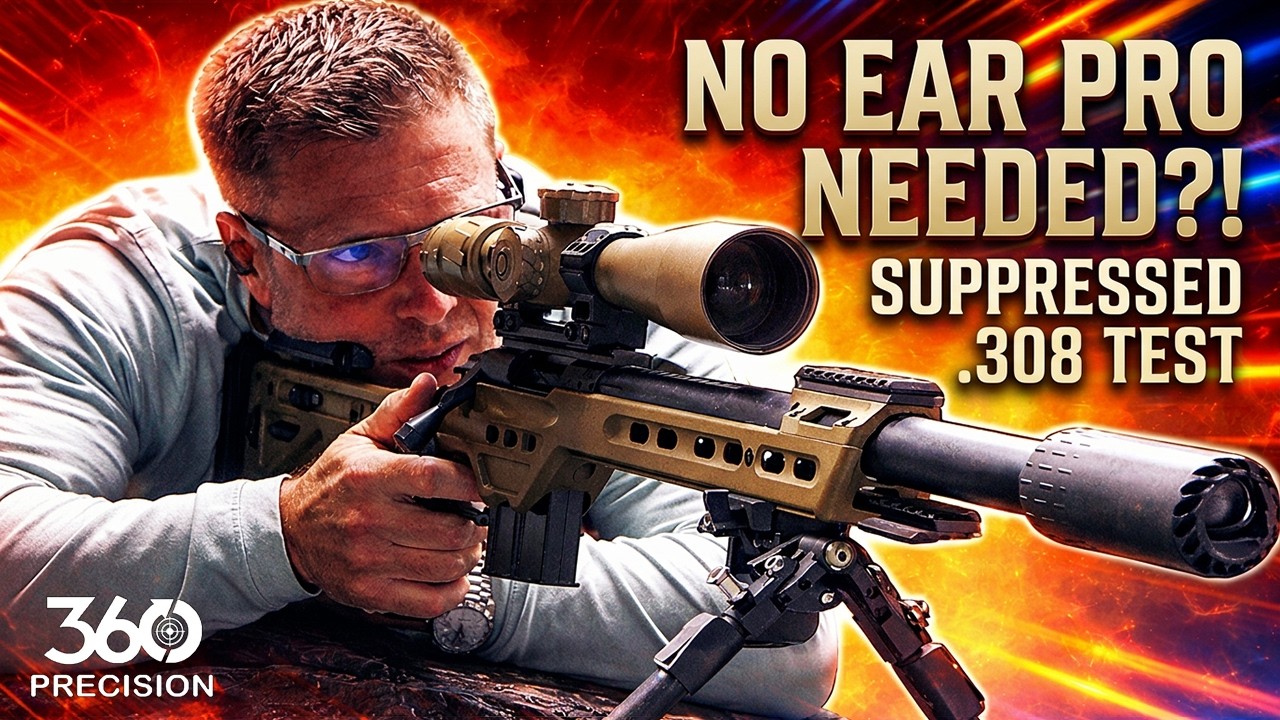
The rifle in question is the same custom suppressed .308 built for the Allentown SWAT sniper team. Here is what it consists of:
- Chassis: MPA CompPro
- Action: Terminus
- Barrel: Bartlein, 20 inches, chambered in .308
- Suppressor: HuxWorks 762 Flow
- Scope Mount: Area 419
- Optic: Zero Compromise FTE 5-27 (Dan’s personal scope – the SWAT team rifles were fitted with the 4-20)
- Bipod: MDT Gen 1 Sky Pod
- Rear Bag: Armageddon Gear
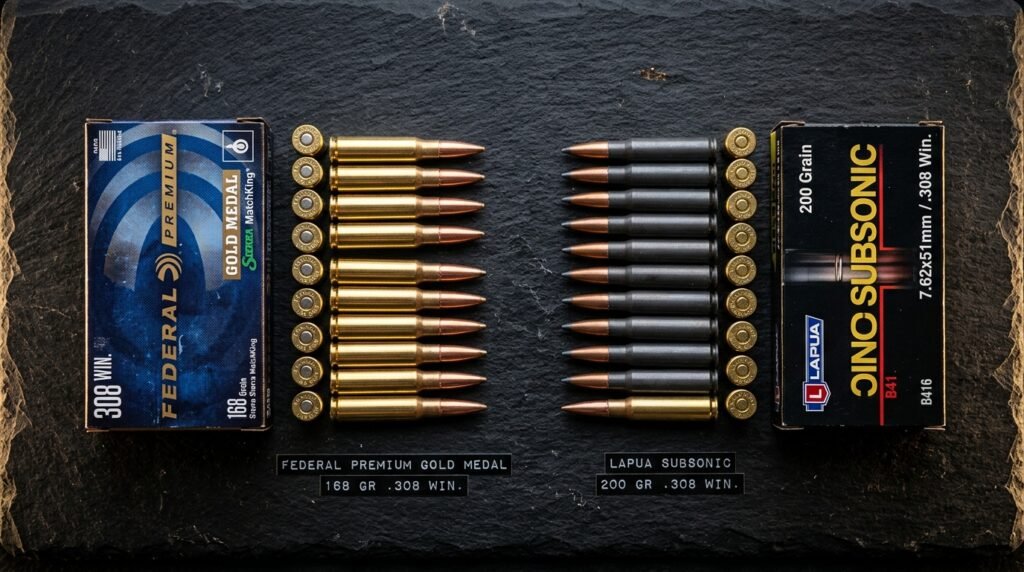
Two ammunition types were tested:
Supersonic: Federal Gold Medal 168 grain – the exact load the Allentown SWAT sniper team uses in the field.
Subsonic: Lapua 200 grain subsonic .308.
The test was run indoors at Survival Trail’s range. Dan notes that shooting this rifle outdoors would produce even better results – the indoor environment adds some echo and reflected sound that pushes the numbers up slightly. But it was 27 degrees outside, so indoors it was.
The Decibel Test: Supersonic vs Subsonic Suppressed .308
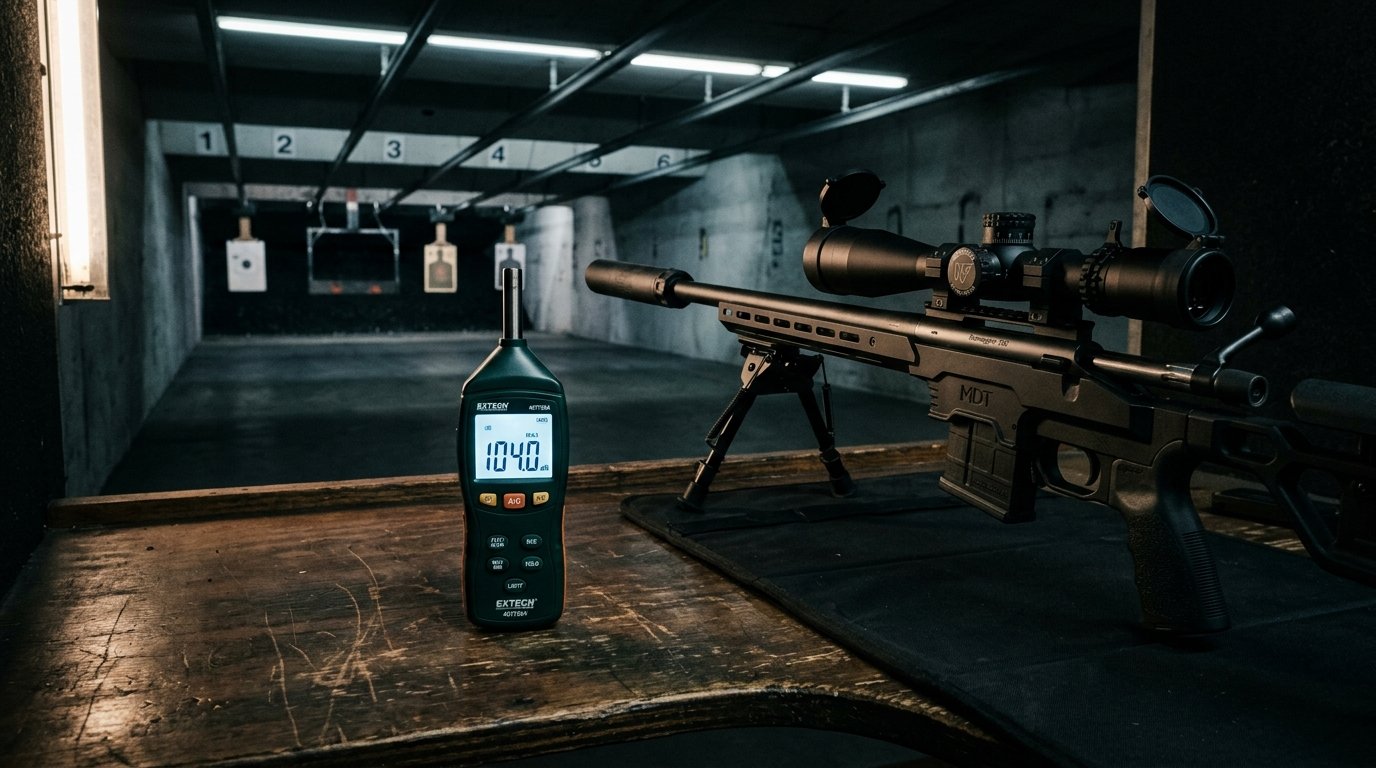
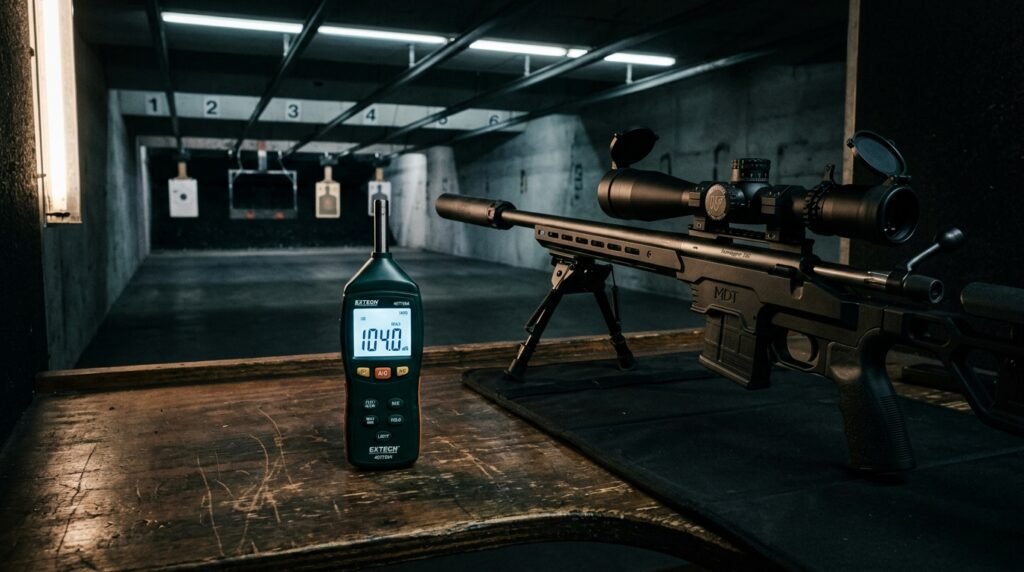
Two shots of each load. Decibel meter positioned to capture the report. Here are the readings:
Suppressed .308 supersonic (Federal 168gr Gold Medal): 104 dB
Suppressed .308 subsonic (Lapua 200gr): 93 dB
That is an 11 decibel drop simply by switching from supersonic to subsonic ammunition. Same rifle. Same suppressor. Same indoor range. Just a different load.
To put that in context: every 3 decibels represents approximately 10 times the sound energy. So 104 dB versus 93 dB is not a minor difference – that 11 dB gap represents a very significant reduction in the actual sound reaching the shooter and anyone nearby.
What accounts for the difference? With supersonic ammunition, even a suppressed rifle still produces the sonic crack of the projectile breaking the sound barrier. That crack is outside the suppressor’s ability to reduce it – the suppressor can only address the muzzle blast, not the ballistic crack of a supersonic projectile traveling downrange. When you switch to subsonic ammunition, you eliminate that crack entirely. The suppressor then only has to manage the muzzle blast, which it handles very effectively.
“Really what you’re hearing with the supersonic is that sonic boom basically happening by the ammunition – and we’re indoors so it echoes. With the subsonic we’re not having any of that. This is just simply the round going off and everything being suppressed.”
93 dB suppressed subsonic, indoors, in the middle of winter. Outdoors on a warm day the numbers would be even better.
For more on what makes a suppressor work effectively – including caliber selection, barrel length requirements, and pressure ratings – see our gunsmith Q&A on suppressor selection.
The Chronograph Data: How Fast Are These Bullets Actually Traveling?
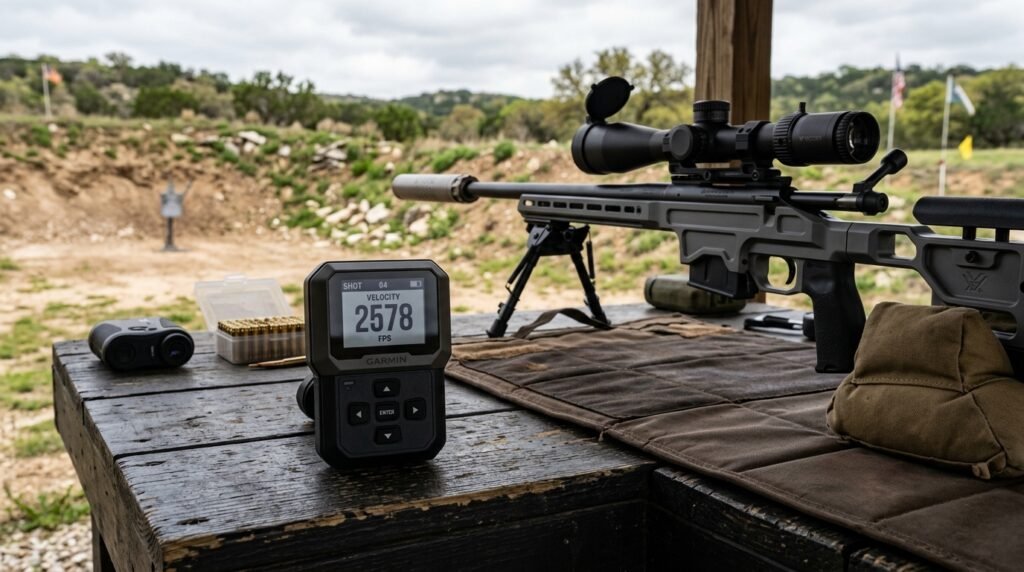
After the decibel testing at Survival Trail, Dan returned to the 360 Precision range to run both loads over a Garmin chronograph. Two shots of each to get a reliable average.
Subsonic Lapua 200gr – Speed Results
- Shot 1: 1,025 feet per second
- Shot 2: 972 feet per second
- Average: approximately 998 feet per second
Just under 1,000 feet per second. The speed of sound at standard conditions is approximately 1,125 feet per second. At 998 fps, this load is comfortably subsonic – which is exactly why there is no ballistic crack. The projectile never breaks the sound barrier, so there is nothing for a bystander to hear beyond the suppressed muzzle report.
Supersonic Federal Gold Medal 168gr – Speed Results
- Shot 1: 2,560 feet per second
- Shot 2: 2,596 feet per second
- Average: approximately 2,578 feet per second
That is roughly 1,580 feet per second faster than the subsonic load – more than double the velocity. At 2,578 fps, this is a full-power .308 load delivering the terminal performance and barrier penetration the Allentown SWAT team needs for duty use. It is also why that 104 dB reading on the decibel meter is higher – that supersonic crack is real and measurable.
“Obviously you got about 1,600 feet per second faster shooting the supersonic. With the subsonics we’re below the speed of sound so we’re not having that crack. With the Federal we’re moving at almost 2,600 feet per second.”
The speed gap between these two loads is about as dramatic as it gets within the same caliber. A 200 grain subsonic .308 running at 998 fps and a 168 grain match load at 2,578 fps are very different tools – each suited for a specific purpose.
What the Recoil Actually Looks Like
One detail from the video that does not show up in the numbers is the recoil comparison between the two loads on this suppressed .308 build.
With the subsonic Lapua 200 grain, the rifle essentially does not move. Dan demonstrated this on camera and the word he used was “ridiculous” – as in, it is ridiculous how little this rifle moves when you fire a suppressed subsonic .308 through it. The combination of the HuxWorks 762 Flow suppressor, the MPA CompPro chassis, and the low-pressure subsonic load produces something that looks and feels more like a rimfire than a centerfire rifle.
With the Federal 168 grain supersonic, there is more movement – it is still a well-managed and suppressed .308 – but the difference between the two loads in terms of felt recoil is striking.
This matters for precision shooting. Less movement means faster target reacquisition, more consistent follow-through, and reduced fatigue over a long shooting session. For a SWAT sniper who may need to make rapid successive shots or confirm a hit through the scope, a suppressed subsonic .308 that barely moves is a significant tactical advantage.
For a deeper look at how recoil management and body position affect shot quality, see our guide on the one body position rule for accurate rifle shooting.
Why This Build Uses a 20-Inch Barrel
The Bartlein barrel on this rifle is cut to 20 inches. That is a deliberate choice for a suppressed .308 build, and the reasoning is worth explaining.
Shorter .308 barrels – 16 or 18 inches – are popular for more compact builds, and they do produce good accuracy. But every inch of barrel you remove costs you muzzle velocity, and on a .308 that loss adds up. For a duty rifle where the supersonic load needs to deliver full terminal performance and barrier penetration at the distances a SWAT team operates, retaining that velocity matters.
The 20-inch barrel running the Federal 168 grain produced an average of 2,578 fps. Running the same load through a 16-inch barrel would produce meaningfully less velocity – potentially 100 to 150 fps less depending on the specific load.
With the suppressor adding approximately 5 inches to the overall length, a 20-inch barrel brings the total muzzle-end length to around 25 inches – manageable for a precision rifle that will be deployed from static positions rather than run through doors.
A full breakdown of barrel selection, contour, and wear is covered in our article on what a worn barrel actually does to your accuracy.
Supersonic vs Subsonic Suppressed .308: Which Do You Choose?
The data from this test makes the tradeoffs very clear.
If your priority is maximum sound reduction: Subsonic wins decisively. At 93 dB suppressed, the Lapua 200 grain running at 998 fps eliminates the ballistic crack entirely. The result is a rifle that is, in Dan’s words, “super quiet. Absolutely really cool.” For training scenarios, stealth applications, or any situation where minimizing sound signature is the goal, subsonic suppressed .308 is the answer.
If your priority is full tactical capability: Supersonic is the duty load. The Federal 168 grain Gold Medal at 2,578 fps delivers the terminal performance, barrier penetration, and long-range accuracy that a SWAT sniper team needs. At 104 dB suppressed, it is still significantly quieter than an unsuppressed .308 – which runs in the 165-170 dB range – but the ballistic crack means it is not as quiet as subsonic.
The Allentown SWAT team carries the Federal 168 grain as their duty load for exactly this reason. When the shot needs to perform through a barrier, at distance, with guaranteed terminal effect, the supersonic load is the one that delivers. The suppressor is there to protect shooter hearing, reduce muzzle blast for the team, and eliminate the physiological toll of unsuppressed fire over a training career.
For context on the full suppressed .308 SWAT rifle build and how it was spec’d out, see our article on what most shooters get wrong according to a SWAT sniper.
Where This Testing Happened: Survival Trail, Pipersville PA
The decibel testing was conducted at Survival Trail in Pipersville, Pennsylvania – one of 360 Precision’s dealers. They were gracious enough to open their indoor range for the test, and the indoor environment actually works in favor of honest data: if anything, the enclosed space adds reflected sound that pushes the decibel readings slightly higher than you would get outdoors. The suppressed .308 hitting 93 dB indoors in winter means the outdoor numbers would be even more impressive.
The chronograph portion was run back at the 360 Precision facility using a Garmin chronograph to capture accurate bullet speed data for both loads.
The Bottom Line: What the Data Actually Tells You
Here is what this test proves in concrete numbers:
- A suppressed .308 running supersonic duty ammo registers 104 dB indoors
- Switching to subsonic drops that to 93 dB – an 11 dB reduction
- Supersonic Federal 168gr averages 2,578 fps out of a 20-inch barrel
- Subsonic Lapua 200gr averages 998 fps – comfortably below the speed of sound
- The felt recoil difference between the two loads on this platform is dramatic – the subsonic barely moves the rifle
A suppressed .308 is not a niche tool for special circumstances. It is a precision rifle system that performs at full capability while protecting the shooter and everyone around them from cumulative hearing and neurological damage. The data from this test makes that case better than any opinion piece could.
If you are building a precision .308 or evaluating a suppressed setup, the numbers are now on the table.
Subscribe to the Accuracy Matters YouTube channel for builds, live testing, and precision rifle content. Follow 360 Precision on Instagram for behind-the-scenes updates and new builds.