Your rifle used to print tight groups at 100 yards. Now, months later, you’re struggling to keep it under 2 MOA. You haven’t changed anything, but your accuracy has mysteriously vanished. What happened?
This is one of the most common questions the 360 Precision gunsmiths hear, and the answer isn’t always obvious. In this comprehensive guide, we’ll break down everything from barrel manufacturing processes to receiver materials, and walk you through the most common reasons your rifle has stopped shooting straight.
Understanding Barrel Manufacturing: Cut Rifled vs Button Rifled vs Hammer Forged
Before we get into troubleshooting, it’s important to understand how your barrel was made. The manufacturing process directly impacts accuracy potential, and knowing this will help you make better decisions when building or buying a precision rifle.

Cut Rifled Barrels: The Gold Standard
Cut rifled barrels are what you’ll find in high-end precision rifles used for competitive shooting. The process involves pulling a single-point cutting tool (essentially a small hook) through a rotating barrel. This cutter removes an incredibly small amount of material – we’re talking about 0.00001 inches per pass.
The key advantage of cut rifling is that it’s a stress-free process. Because you’re simply cutting grooves rather than forcing metal, there’s no induced stress that needs to be relieved. The result is an extremely consistent barrel that maintains its accuracy over time.

Pros of cut rifled barrels:
- Highest accuracy potential (sub-MOA guaranteed when done right)
- No stress relieving required
- Extremely consistent results
- Hand-lapped for optimal finish
- The gold standard for precision rifles
Cons:
- More expensive due to slower manufacturing
- Takes longer to produce
- Requires specialized equipment
Major manufacturers like Bartlein, Kreiger, and Benchmark produce cut rifled barrels, and these are typically found on rifles costing $3,000 and up.
Button Rifled Barrels: The Practical Alternative
Button rifling uses a “button” – a hardened steel tool with the inverse pattern of the rifling engraved on it. This button is pulled through the bore, and as it twists, it deforms the metal to create the rifling pattern. Think of it like pushing Play-Doh through a mold rather than cutting it with a knife.

The trade-off is that button rifling induces significant stress into the metal. Because the process actually rips and deforms the steel rather than cutting it, the barrel must undergo stress relieving and a more intensive lapping process to achieve its full accuracy potential.
Pros of button rifled barrels:
- Faster and cheaper to produce
- Good accuracy when properly processed
- Most mass-produced rifles use this method
Cons:
- Requires stress relieving (additional step)
- More intensive lapping needed
- Higher probability of inconsistencies
- More dependent on quality control at each step
The critical thing to understand is that a properly made button rifled barrel can shoot just as well as a cut rifled barrel. However, because there are more steps involved, there’s more room for error. If any step isn’t done perfectly – the stress relieving, the lapping, the button quality – you may see accuracy issues.
For most shooters, the difference between cut and button rifling won’t matter. But if you’re competing at a high level or trying to achieve quarter-MOA groups, the consistency of cut rifling gives you a statistical advantage.
Hammer Forged Barrels: The Manufacturing Powerhouse
Hammer forging (also called cold hammer forging) is a completely different process. A mandrel – essentially a full-length hardened steel form with the rifling pattern – is inserted into a bore hole. Massive hammers then strike the exterior of the barrel, forcing the steel to conform to the mandrel’s shape.
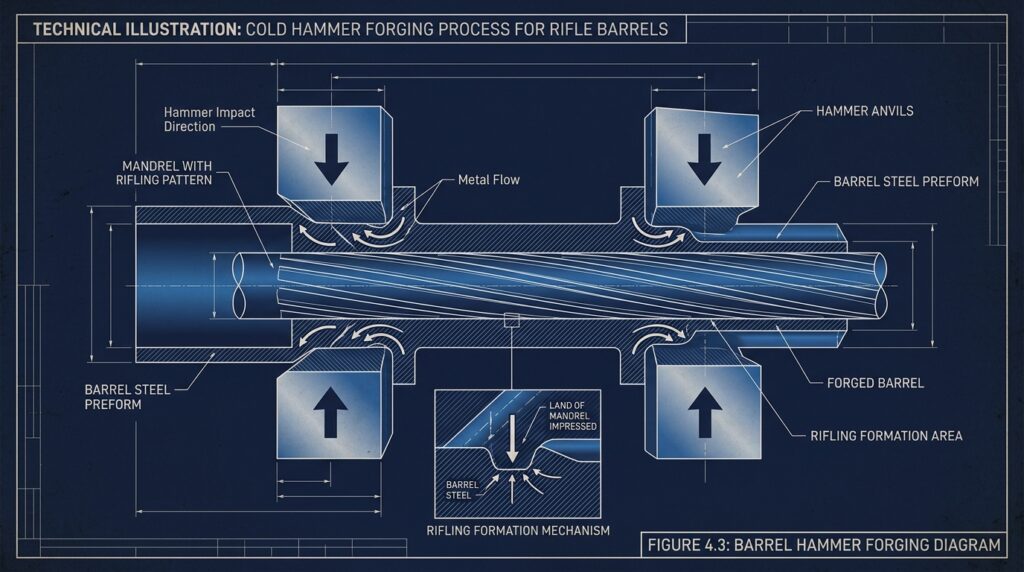
This process is used by major manufacturers for semi-automatic rifles and has become common in AR-platform rifles. The benefits are impressive:
Pros of hammer forged barrels:
- Extremely durable (the process actually work-hardens the steel)
- Fast production speed
- Very consistent for mass production
- Excellent for semi-automatic applications
Cons:
- More expensive than button rifling
- Requires expensive specialized equipment
- Generally not used for the highest-precision applications
You’ll find hammer forged barrels in rifles from manufacturers like Colt, FN, and others producing military and law enforcement weapons. They offer an excellent balance of durability and accuracy for most practical applications.
Receiver Materials: Billet vs Forged vs Polymer
Moving from the barrel to the receiver, let’s examine the three main options and their impact on your rifle’s performance.
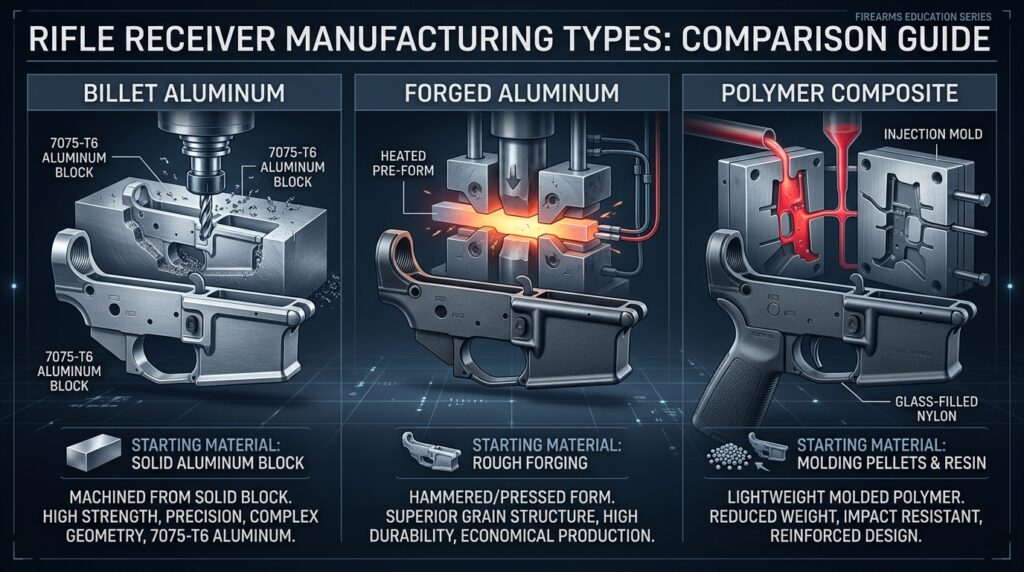
Billet Receivers: Machined Precision
Billet receivers start as a solid block of 7075 aluminum – typically an 8-pound block that gets machined down to around 8-9 ounces. This gives the manufacturer complete control over every dimension and angle.
Why choose billet:
- Tightest tolerances possible
- Complete design flexibility (you can make it look however you want)
- Better accuracy potential due to precision machining
- No limitations on styling or ergonomics
The 360 Precision team uses 7075 aluminum billet for their custom builds because it allows them to achieve the tightest tolerances and cleanest aesthetics. The trade-off is more waste material and longer machining time.
Forged Receivers: The Traditional Standard
Forged receivers start as a forged steel shape that’s stamped close to final form. Less material needs to be removed, making the process faster and more economical.
Pros of forged receivers:
- Faster production time
- Less waste material
- Proven durability (forged parts have been standard for decades)
- Lower cost
Cons:
- More limited design options
- Cannot achieve the same tolerances as billet
- Less visual customization possible
For most practical applications, forged receivers offer more than sufficient strength and accuracy. The difference really matters only at the highest precision levels.
Polymer Receivers: Light but Compromised
Polymer receivers have become popular in some circles, particularly for building the lightest possible rifles.
The reality:
- Yes, they’re lighter than aluminum
- But they require metal reinforcement in critical areas
- Significantly shorter life expectancy
- Not suitable for high-precision applications
- Not recommended by most professional gunsmiths
If your goal is a 4-pound rifle for ultralight backcountry hunting, polymer might be worth considering. For any serious accuracy application, stick with 7075 aluminum.
Stock vs Chassis: The Personal Preference Debate
This is where individual shooter preference truly matters. Both stocks and chassis systems have their place, and neither is inherently “better.”
Traditional Stocks
Most stocks are made from fiberglass or synthetic materials and require bedding (the process of filling gaps between the stock and action with epoxy to create a solid interface).
Stock advantages:
- Classic look and feel
- Some shooters report better “connection” to the rifle
- Wood stocks (like Turkish walnut) offer aesthetic appeal unmatched by any other material
- Some modern stocks (like Manners) don’t require bedding
Stock considerations:
- Bedding adds time and cost
- Fewer adjustment options
- Less modular than chassis systems
The Foundation stock, made from micarta (compressed fabric and resin), is one example that offers incredible durability without requiring bedding. It’s become popular among competitive shooters who want a traditional look without the bedding requirement.
Chassis Systems
Chassis systems provide an aluminum framework that the action sits in, similar to how a rifle stock works but with more integration points.
Chassis advantages:
- Quick adjustment capability (cheek riser, length of pull)
- More mounting options (M-LOK slots for weights, accessories)
- Often more durable
- No bedding required
- Better for adding weights for balance
Chassis considerations:
- Generally heavier
- Some shooters feel less “connected” to the rifle
- More complex appearance
The honest answer is to try both before buying. What works for one shooter might feel completely wrong for another. Visit a PRS match or find a range that has both options available and shoot them back-to-back.
Why Your Gun Stopped Shooting Straight: Troubleshooting Guide
Now let’s address the main question: why has your previously accurate rifle started missing?
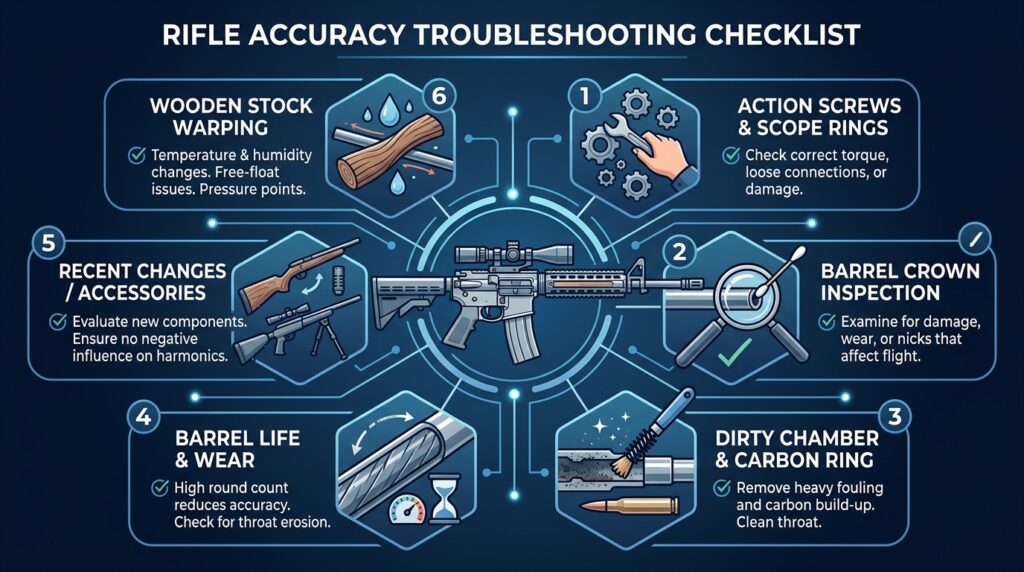
1. Check Your Hardware First
The most common causes of lost accuracy are loose components:
- Action screws – Check that your action screws are still torqued to spec
- Scope rings – Inspect for any movement or stress on the scope tube
- Scope base – Verify the base hasn’t shifted
- Torque specifications – Use manufacturer specs. Too much torque on scope rings can actually bend the scope tube, causing tracking issues and lost zero.
2. Inspect the Crown
The crown is the last point of contact the bullet has before leaving the barrel. Even a small ding or burr can cause dramatic accuracy loss.
Quick check: Take a Q-tip, gently push it into the crown, and pull it out. If any cotton fibers catch or tear, you likely have a burr or damage that needs professional attention.
If you suspect crown damage, don’t attempt to fix it yourself – take it to a reputable gunsmith. A proper crown repair requires specialized equipment and expertise.
3. Is Your Gun Dirty?
Carbon buildup in the chamber can cause accuracy issues even when the bore looks clean. This is particularly common in certain calibers.
Watch for:
- Carbon ring forming at the neck of the chamber
- Excessive fouling in the chamber area
- Difficulty extracting cases
If your rifle has gone thousands of rounds without proper cleaning, this could definitely be your issue.
4. Barrel Life
All barrels eventually wear out. Hot calibers like 6mm Creedmoor and .284 Winchester tend to burn out barrels faster due to the velocities involved.
Signs of a shot-out barrel:
- Random flyers (one shot far off from the group)
- Groups suddenly opening up
- Extreme spread on your chronograph increasing
If you’ve put 3,000+ rounds through a match barrel, especially in a hot caliber, it may simply be time for a replacement.
5. Recent Changes
Did you change something between the last time it shot well and now?
- New scope?
- Different muzzle device?
- Added a suppressor?
- Changed scope rings?
If you changed anything, put it back to how it was when the rifle shot well and test again. This is the simplest way to isolate whether a change caused your problem.
6. Wooden Stock Warping
If you have a wooden stock and store it in an uncontrolled environment (attic, garage, shed), humidity and temperature changes can cause the wood to warp. This can put pressure on the barrel or action, changing your point of impact.
The Bottom Line
Your rifle’s lost accuracy is almost certainly caused by one of the factors above. Start with the simple checks – loose screws, dirty bore – before assuming the worst. Many accuracy issues are resolved with basic maintenance.
If you’ve gone through this checklist and still have problems, it may be time to consult a professional. The 360 Precision gunsmiths have seen every common issue and can help diagnose what’s happening with your rifle.
Related Articles:
- What a Worn Barrel Actually Does to Your Accuracy
- Gunsmith Answers: Calibers, Cleaning, Muzzle Brakes and Suppressors
- Is Bigger Always Better? Expert Gunsmiths Answer the Question
Watch the Video: Gunsmith Answers: Why Your Gun Stopped Shooting Straight