Guy Valerioti’s long range shooting class was one of the first classes Dan Cogan took after getting into precision rifle. Students who can hold a 1 to 1.5 inch group at 100 yards are hitting 1,000 yards right after lunch on day one. And the biggest problem the instructors fix isn’t the long shot itself. It’s a rifle that isn’t set up to the shooter.
From Funeral Director to Undercover to Marshals Entries
Guy didn’t start out in law enforcement. Guy went to college to be a funeral director and worked in that field for years, while taking every police test out there and not getting hired. Two recruits dropped out of the academy the day before it started, a sheriff’s office investigator tracked Guy down, and Guy was hired by the sheriff’s office on Long Island in 1996.
After three or four years in uniform, Guy moved to a gun, gang and narcotics task force with the DA’s office and worked undercover for 11 years. Guy’s theory is that undercover officers make outstanding SWAT operators, because undercover work teaches you to control your adrenaline. Going in, Guy had to memorize the layout of a place: the doors, the entries, whether there was a dog, faces and heights, with backup far away.
Guy also became a firearms instructor, taking top shot at pistol instructor school and at the FBI’s carbine instructor school, and went to SWAT school, mostly with the FBI. Guy never really competed. Guy’s team was loaned to the U.S. Marshals, and for the final couple of years Guy was deputized to do entries full time. Guy thinks the Marshals do more entries than anyone in the country. They did entries almost every day, sometimes three to five a day, and once hit about 40 hotel rooms in a single day, from roughly 3:30 to 8:30 in the morning.
Each year, Marshals phase training looked at the shootings around the country and tweaked tactics based on them. When COVID shut entries down, Guy retired after 24 years and moved to North Carolina.
How Ghost Firearms Started
Ghost Firearms started in 2014, half as a goof, running carbine courses. It grew out of the training Guy had sat through and kept thinking, “I wish we did this in training.” So Guy outlined classes the way Guy would want to take them: no listening to war stories all day, and not two days of shooting cardboard, but tactical work around cars and barricades, malfunctions and magazine changes.
The name came from Guy’s wife. Back in the funeral director days, they lived on a cemetery, and Guy’s wife suggested “Ghost.” The O in the logo became the crosshair.
Long range classes started at Mifflin with Guy’s friend Paul, an instructor. Early on, there was little steel, and the instructors would set up three or four yard lines and then run out and move the target stands further back. Now Ghost has conexes and trailers full of steel, including animal steel with reactive vitals for the Hunter class. They’ve been running long range for about 12 years.
These days Guy’s rifle of choice is a 360 Precision Evolution Rifle, set up for positional and long range shooting. Guy calls it “insane,” has shot it out to 1,200 yards, and plans to take it to a mile next.
What a Beginner Long Range Shooting Class Expects From You
Ghost’s class is beginner long range precision, not a beginner rifle class. The prerequisite is simple: if you can shoot a 1 to 1.5 inch five-shot group at 100 yards, you can take it.
From there, students are hitting 1,000 yards on day one, right after lunch. In Guy’s words, it’s not that difficult when someone is telling you what to dial. Guy thinks people expect 1,000 yards to be harder than it is, and with a steady 2 to 4 mph wind it’s not that difficult. By the end of class, students able to shoot a clay target at a 1,000 yards.
Mifflin County Sportsmens Association, near Penn State in Pennsylvania, uses a mountain as the back stop and has berms every 100 yards. Even in poor conditions you can spot hits and misses.
The Biggest Mistake: A Rifle That Doesn’t Fit You Prone
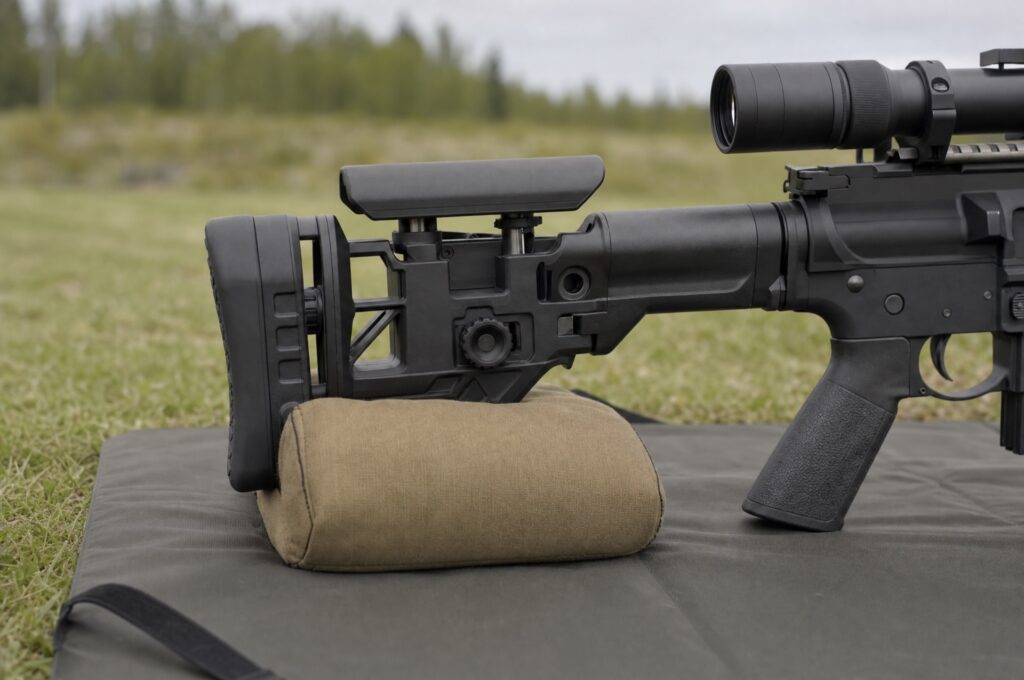
The biggest problem Guy sees with beginner and intermediate students is that they aren’t set up to their rifles. Most people shoot from a bench, where you can move your head forward, backward, up and down to center your eye in the scope.
Prone, that doesn’t work. The rifle has to be set up so your head falls in the exact right spot, with the right length of pull and a clear view through the scope. The instructors are constantly moving scopes and readjusting rifles in class. (If prone body position is new to you, see natural point of aim.)
The cheek piece has to carry the full weight of your head. If your neck is holding your head up even the slightest bit, after half an hour you’re going to be in pain.
Dan’s summary of what it takes: a good quality rifle fitted properly to you, then your dope, the call, spotting your misses and reading the wind.
Why Students Start Missing When the Coaches Step Away
Dan remembers a break in class when nobody was calling shots, and everyone started missing. Guy’s explanation: students rip off 60 rounds in two minutes and get the barrel hot.
A few habits show up over and over:
- Coming off the scope. A lot of people don’t stay in the scope ready for a follow-up shot. They come off it and have to reacquire everything.
- Trigger control. For most beginners, it’s pretty awful.
- Setup behind the rifle. The instructors teach students to stay in the rifle, load the bipod and get the rear bag well set.
Steel also helps. Shooting steel is much easier, and once nervous shooters whose 100-yard groups were bad start shooting steel, they settle right in.
At least one rifle every class has something come loose, so the instructors now check that first. Dan’s example: a friend’s scope was wobbling even though it was tightened to “manufacturer spec.” Once they tightened it back down, it instantly went sub-1 MOA.
Long Range Class Readiness Checklist
Check what’s true for you today. Built only from what Guy Valerioti says Ghost Firearms’ instructors see in a beginner long range class.
General information from the episode, not instruction. Questions about your rifle setup? Reach out to us.
Scope Magnification for 1,000 Yards: Back It Off
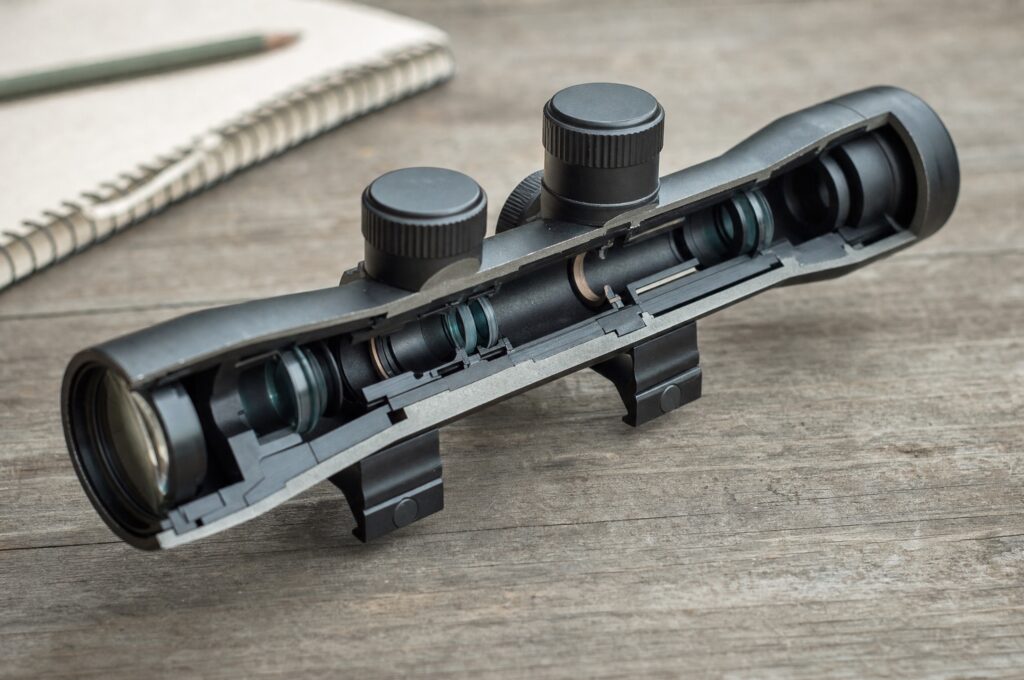
Don’t sit at max power. When Ghost’s students are shooting out to a mile, they’re on 18 to 20 power.
High magnification has its place. Guy uses 25 or 35 power to read a plate card at 100 yards, or to identify a face for police sniper work, because you’re only compressing 100 yards of atmosphere. On a hot sunny day at 1,000 yards, that much magnification compresses a lot more atmosphere, and it’s going to look like soup.
Backing off gives you a wider field of view, so you can see where your impact or miss went.
Learning How a Rifle Scope Actually Works
A lot of students have no idea how a scope works, and Dan admits to not knowing either when he first starting shooting long range. Guy uses cutaway scopes to show the erector tube, the parallax lens and what each knob does. Once it’s not a mysterious black tube where they’re just turning knobs arbitrarily, students are more comfortable.
Guy and Dan are both visual learners, and Guy finds most people are. That’s why Guy also built a big parallax display with moving lenses and big dials.
Reading Wind: The Spotter-Shooter Class and Mifflin’s Tricky Range
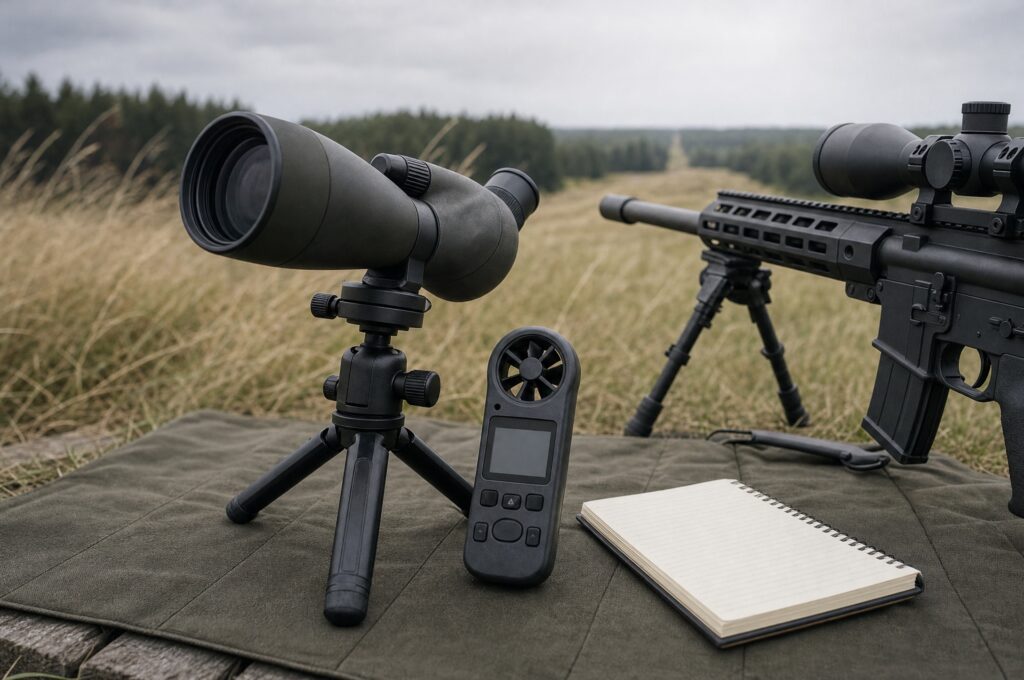
Ghost also runs a spotter-shooter class. Partners swap between the spotting scope and the rifle. Students read the wind with Kestrels and record their calls, then check how many they got right and how far off they were in mph. (Related: wind calls and gun speed.)
Mifflin is a good place to learn it, because the winds get very tricky there. Wind can come over the mountain and shift midday, and the big cut in the trees from the 500-yard range gives you a different wind. At Dan’s first PRS match there, rain came over the mountain and the wind shifted to a straight headwind, blowing bullets down.
Dan sees steps in difficulty: one around 700 to 800 yards and another around 1,300 yards, and each one demands more skill. At Mifflin, Guy says the 900-yard target messes everyone up, and Guy doesn’t know why.
The Hunter Class at Ben Franklin Range
The Hunter class runs at Ben Franklin range in Templeton, Pennsylvania, north of Pittsburgh. It’s rolling natural terrain, with targets set from 1,100 to 1,800 yards: more than 50 targets, including eight life-size steel animals with reactive vitals. It runs toward the end of the year, right before hunting season, as a refresher.
The range itself is big: 1,100 acres, a 6,000 square foot shoot house, multiple carbine ranges, an unknown-distance range and a mile range.
Not everything at Ghost is practical. Guy built a cage for a truck bed, and at the end of day one, carbine students shoot from the moving truck. It has no practical use, but it’s fun. Guy’s own hit rate from the truck is maybe 20 to 30%.
What Happens in a Civilian CQB Class
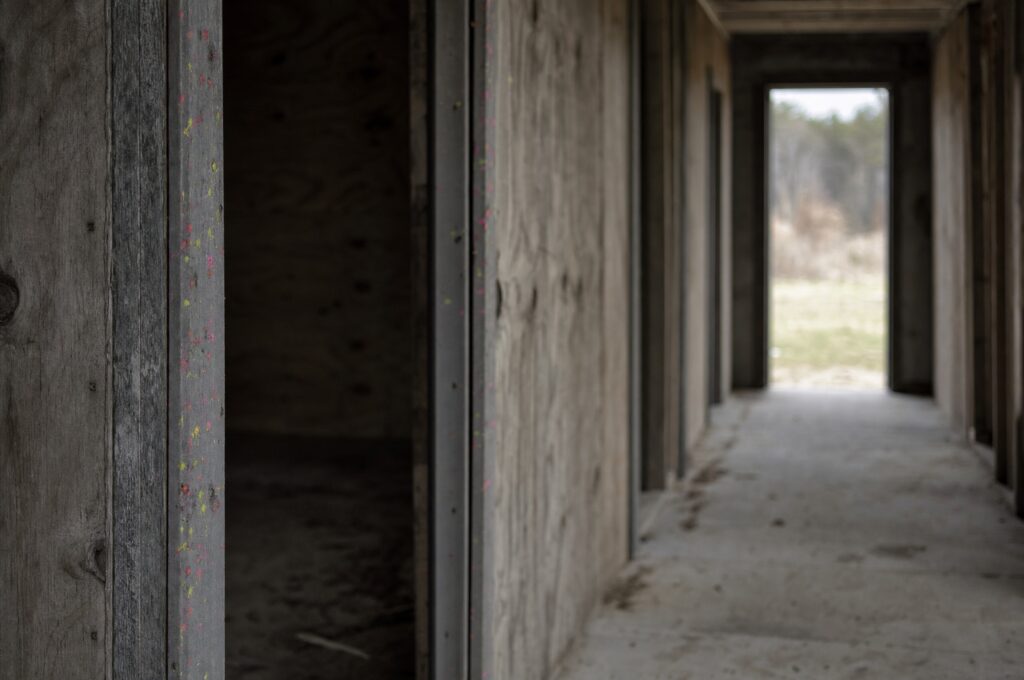
All of Ghost’s CQB is shoot house training at Ben Franklin, using simunitions. It takes a five-day police basic SWAT school and condenses it into two days. Civilians are welcome, and you don’t need any experience, although SWAT teams and police officers have taken it too. You just need to know how to run your AR.
You need eye protection and some sort of head covering, because someone gets hit in the head every class.
Here’s how the two days run:
- Safety brief, then the shoot house. Students are split into five-person teams that stay together, with five or six instructors.
- Stations. Center-fed rooms, corner-fed rooms, T-intersections, opposing doors, and opening and closing doors, rotating about every 45 minutes.
- Shoot/no-shoot. Paper targets, then open doors.
- Role players. Right after lunch on day one, bad guys start shooting back.
- The whole house. Rooms expand to hallways, bathrooms, both floors and the stairs by the end of day two. Guy says people overcomplicate stairs, and a lot of things.
- Low light and fog. Students choose intermittent or constant light, then work a downstairs section filled by a fog machine, which forces everything to slow down. There can be up to six bad guys in the house.
The Most Common CQB Mistakes
By far the most common error is stepping through the doorway to dig the deep corner. It’s footwork, and the instructors spend an hour to an hour and a half at the start of class just on getting through the doorway.
Almost everyone also comes through with the muzzle pointed down. Guy wants it at low ready, not at the ground.
The second big problem is not trusting teammates. When shots go off somewhere else in the house, people leave their sector, and that’s when the instructors pop a role player through the open door. Guy’s rule is to solve one problem at a time: there’s a reason you’re on a team. It ties back to something from Guy’s undercover days that Guy tells CQB students: “You’re looking, but you’re not seeing.”
Why Civilians Often Outperform the SWAT Team
Every class gives away a Top Shot trophy. One SWAT team lost top team because it left a room unchecked behind it and went upstairs.
Guy finds civilians always do really well, because they seek out the training. Guy contrasts that with police training. Guy’s academy was about 80% book work, with little shooting or tactics, and many officers shoot 60 rounds a year for qualification. In Guy’s view, it all comes down to budget. Some of the training Guy wanted, the department wouldn’t pay for: when Guy went to one of Larry Vickers’ classes, Guy paid for it personally.
Why You Train to Fight With a Hit Hand
You get hit in the hands all the time in this kind of fight, because rifles are held center mass, right where everyone is aiming. Guy puts it at a good chance, about 60% of the time.
That’s why Ghost’s carbine class runs down-limb drills, with a taped-up hand and fake blood. The point is that you’re not giving up the fight. One of Guy’s videos of those drills got 80 million views.
Carbine Scenarios and TacMed
One carbine drill comes straight from Marshals phase training. A student sits in a car under a tarp, the instructors shake the car and pull the tarp off, and the student reacts to a scenario. That first student then watches everyone else go. Twenty students will have twenty completely different reactions, and Guy learns from watching them. Given the choice, Guy would rather rein in an overly aggressive student than push a hesitant one.
The TacMed class is taught by Billy, Guy’s medic from the DOJ team, who is still working. It covers care under fire, bounding to a downed teammate, putting on tourniquets while being sprayed with fake blood, then full medical: cutting away clothes, finding the hole and applying chest seals. To Guy, it’s one of the best classes Ghost runs. (Related: range medical.)
What Makes Ghost’s Instruction Different
Ghost teaches pistol, long range (beginner and intermediate), Hunter, carbine, CQB and med. Guy taught himself a lot of long range, sought out classes, has been to Bryan Litz’s ballistics seminars and reads Litz’s books.
There are five instructors at every class, with backgrounds in police, military, combat, combat medicine and PRS: Trevor handles reloading, for example, and Zack is a Marine Scout Sniper. Guy’s point is that a great background doesn’t make a good instructor. You could take the best Navy SEAL there is, but if that person can’t relay it so students understand, it doesn’t help. A second instructor explaining the same thing a different way often does.
Nobody at Ghost does it for a living. Every instructor has a full-time job, and they teach 12 to 14 weekends a year. The priorities are in order:
- Everyone goes home with the same number of holes they came with.
- Have fun, and do things you can’t do at your home range.
They work to relax nervous precision students, they’re at the range with you for 48 hours, and they hang out afterward with beers and cigars. Guy estimates at least 50 to 60% of students are repeats. Ghost asks for feedback and changes something almost every class.
Dan’s take on any class, good or bad: even a bad class will teach you something, if you’re looking and open to it.
The Bigger Picture: Skills Are Perishable
Guy hated teaching pistol, because the shorter the muzzle, the quicker it gets very hard to grab, but got convinced to do it this year. Some skills carry across platforms: trigger control and muzzle awareness definitely do. Dan adds that the trigger press is the same across platforms, and the shotgun is the one difference, since you keep the gun moving and slap the trigger.
Dan thinks pistol is probably the most perishable skill. With a rifle, Dan could stop for five years and be back in a day.
Both agree on one more thing: the 2A community has to stand up for itself, not go after each other. Dan welcomes valid criticism.
Long Range Shooting Class FAQ
At Ghost Firearms, the prerequisite is being able to shoot a 1 to 1.5 inch five-shot group at 100 yards. It’s a beginner long range precision class, not a beginner rifle class, so you’re expected to already run your rifle.
In Ghost’s class, students are hitting 1,000 yards on day one, right after lunch. Guy Valerioti’s view is that it’s not that difficult when someone is telling you what to dial, and with a steady 2 to 4 mph wind it’s not that difficult either.
Not max power. When Ghost’s students shoot out to a mile, they’re on 18 to 20 power. Higher magnification on a hot day at 1,000 yards compresses a lot of atmosphere and looks like soup, while backing off gives a wider field of view so you can see your impact or miss.
According to Guy, it’s a rifle that isn’t set up to the shooter. Prone, your head has to fall in the exact right spot with the right length of pull and a clear view through the scope, and the cheek piece has to carry the full weight of your head.
Yes. Ghost’s two-day CQB class is open to civilians with no experience, and SWAT teams and police officers have taken it too. You need to know how to run your AR, and Guy finds civilians always do really well because they seek out the training.
At Ghost, all CQB is done in a shoot house using simunitions, so role players can shoot back. You need eye protection and some head covering, because someone gets hit in the head every class.
By far, it’s stepping through the doorway to dig the deep corner. Almost everyone also enters with the muzzle pointed down instead of at low ready, and many people leave their sector because they don’t trust their teammates.
Dan Cogan thinks it probably is. With a rifle, Dan could stop for five years and be back in a day. Trigger control and muzzle awareness carry across platforms either way.
Questions for Dan or the 360 Precision Team?
If you have a question about this episode, a rifle setup or anything else you’d like covered on Accuracy Matters, reach out to us. You can also find Ghost Firearms on Instagram, Facebook and YouTube.
Related Reading
- SWAT Sniper Reveals What Most Shooters Get Wrong
- Former MMA Fighter Erik Purcell on Real Combat, Tactical Training and Building a Life on Your Own Terms
- What Goes Into a PRS Rifle Build
- Joe Gentile: The Biggest Mistakes New Shooters Make (and How to Avoid Them)
Everything above reflects the personal setups and opinions of the shooters in this video and is provided for general information only. It is not instruction, and it is not a substitute for safe firearm handling, the rules of your range, or the rulebook of the match you are shooting. Always confirm the legal status of suppressors and any other regulated component in your jurisdiction.