A PRS rifle build is a purpose-built competition rifle, heavy by design and assembled from parts chosen as much for feel as for performance. Dan Cogan and Garrett sat down with both of their competition rifles and went through them part by part, muzzle to buttstock. The two builds differ almost everywhere, and neither shooter thinks the other is wrong.
That last point runs through everything below. These are not hunting rifles and they are not general-purpose rifles. They are built for one job, and most of the choices that go into them are preference rather than performance.
PRS Build Spec Checker
Enter what you are running (or thinking about running) and see how it lines up against the two builds in this article. Everything is calculated in your browser. Nothing is sent anywhere.
Optional. Used to estimate a length change.
Optional.
16 oz = 1 lb.
Fill in whatever you know and press Check my setup. You do not need to fill in every field.
The Muzzle: Suppressor, Brake, and Cover
Both rifles wear an Area 419 Maverick, a modular suppressor with a muzzle brake on the end.
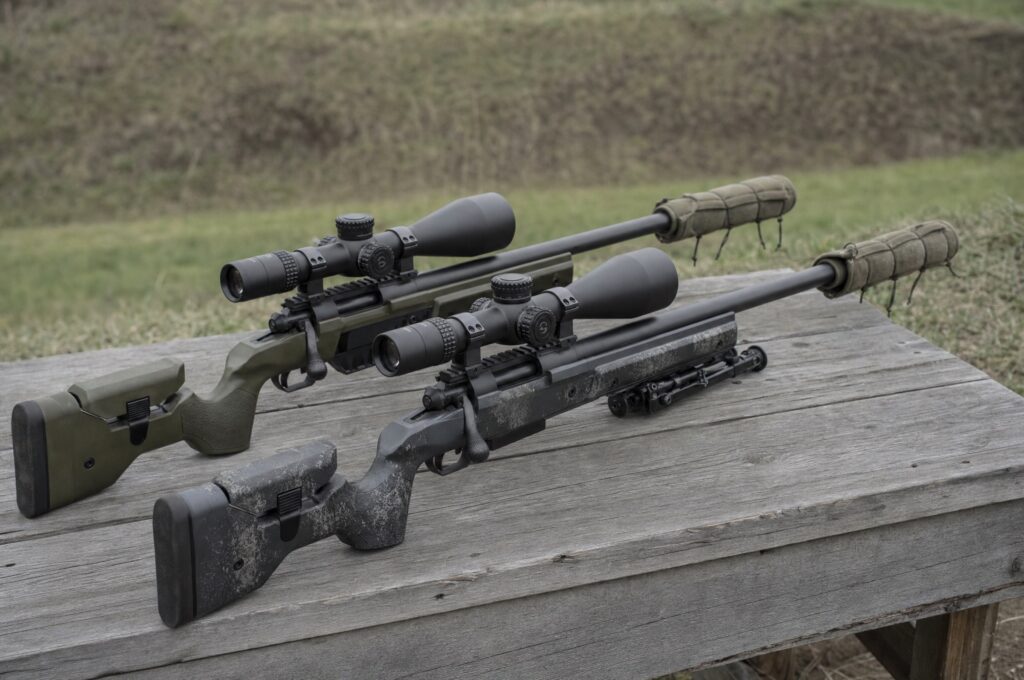
The Maverick is stackable. The serialized section reverse-threads onto a muzzle adapter, and every additional section reverse-threads onto the one before it, so length is something you change rather than something you commit to. Ordered without the brake, it can run as a full nine inch suppressor if all you want is quiet.
Garrett runs his in the shortest configuration. Dan runs an extra baffle section, which makes his slightly longer. The extra baffle gives a different recoil impulse, and the tradeoff is roughly quieter against more recoil reduction. Neither shooter has a strong preference, and which one goes on the rifle sometimes comes down to the match, the cartridge, or the day.
The reason both rifles use the suppressor and brake combination is concussion. Shooting a bare brake for two full days leaves you mentally drained by Sunday. Putting a brake on the end of a can cuts most of that concussion out while still allowing gases to flow through, so you keep recoil reduction and lose some of the bite. The newer version of the brake is thought to be more directional, pulling more gas back toward the shooter.
What you end up with is a deliberate middle ground. It is not as quiet as a full suppressor and it does not do everything a bare brake does. A brake gives you a jolt, a suppressor gives you a more linear push, and this splits the difference. In their experience, people who get behind a Maverick tend to describe it as pleasant to shoot.
Thunder Beast makes a comparable line, and other companies make alternatives and adapters. Their read is that most shooters would have a hard time telling a Thunder Beast from a Maverick side by side. The Maverick has been on both rifles for the two to three years since it came out.
Why a suppressor cover is not optional at a match
A suppressor cover exists to stop mirage from ruining your sight picture.
A PRS stage typically runs eight to twelve rounds. Shoot a twelve round stage on a 90 degree day and the can gets extremely hot. Heat coming off the suppressor and barrel throws mirage that shows up in the scope and interferes with your sight picture. A cover cuts that down.
Garrett runs a Rausch Precision cover, the B model rather than the Pro, chosen for the bungee cord retention and the price. Not shooting a cover off the rifle is a goal, and the bungee cinches down well. Dan runs a Cole-TAC with a Velcro closure and an inner liner. Cole-TAC covers are cut to order, so you give them the diameter and length of your can and they build it to fit. Lead time is around two to three weeks.
There are a lot of covers on the market and no clear winner among them. Some shooters wrap shop rags on with zip ties. The recommended step is simply to run something if you are running a can at a match.
Barrels: Contour, Length, and Rifling
Both rifles use heavy barrel contours, because thin barrels can move their point of impact as they heat up.
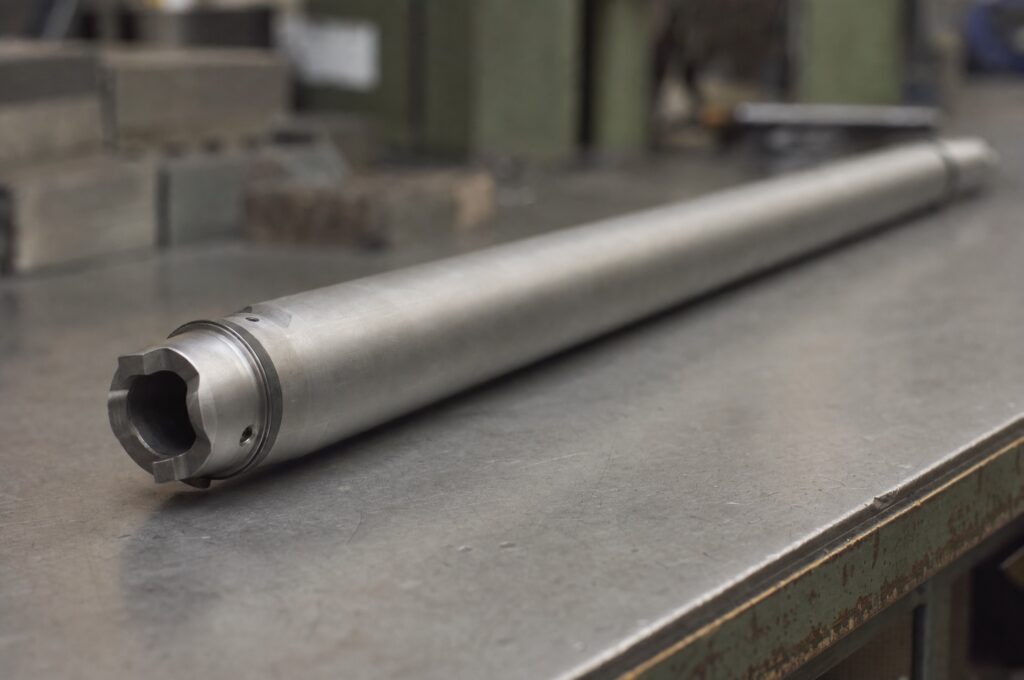
Garrett runs a Bartlein straight contour, roughly 1.25 inches in diameter the whole length, the profile shooters call a truck axle. He picked that one partly because it was in stock. Dan’s barrel is a contour 360 Precision had made, measuring around .960 at the muzzle. A slightly tapered contour stepping down to around .960 or .980 is the middle option for anyone who does not want a full truck axle.
Thin profiles and some carbon barrels can show point of impact shift as they heat. PRS puts heat into a barrel, and every round has to go where it is aimed, so extra material around the bore is worth the weight. Barrel weight is also a balance decision. The trend is toward nose-heavy rifles to control muzzle rise, where the older thinking was to balance the rifle at the magwell. Weight out front counteracts some of the recoil impulse.
On length, one rifle runs 25 inches and the other has run 26, 27 and 28 inches. Twenty-five inches is a good middle ground between weight, balance and speed with the BR and Dasher cartridges. Twenty-eight inches with a suppressor on the end took real practice to run in and out of barricades, and picking up a rifle that long starts from the back rather than the middle. When 360 Precision builds a rifle for someone new to the sport, 24 to 25 inches is the length usually recommended.
Length buys velocity at roughly 20 feet per second per inch. A load running 2,800 fps in a 24 inch barrel lands around 2,840 to 2,850 in a 26 inch barrel, everything else equal.
Bartlein, Krieger and Brux are the barrels both shooters name. Cheaper barrels shoot well, and plenty of people are getting good results from something like a Criterion. What the high-end cut-rifle barrels buy you is consistency. They are not finicky, they take the guesswork out of load development, and the variance from one barrel to the next is much smaller. The cost is money and availability, since they can be hard to source.
Cut rifling is where that consistency comes from. Button barrels can shoot very well, but one might print .45 and the next .35. With a cut barrel and proper load work including seating depth, quarter inch groups are attainable if you are good enough. The practical benefit shows up at rebarrel time: with a good gunsmith and a quality barrel, you can spin on a replacement, get the same chamber, and have the same load shoot the same way. That is the reasoning behind chambering work done to a repeatable spec, and it is why both shooters choose premium barrels. Every variable you remove leaves the shooter as the one that is left. 360 Precision covered cut versus button rifling in more depth in a separate Ask the Gunsmith video, and what a worn barrel actually does to accuracy is worth understanding alongside it.
Where a barrel tuner fits
A tuner fine-tunes a load to a specific barrel, and both shooters have largely stopped using them.
Barrels always have slightly different harmonics, and a tuner lets you work around that without changing the load. Dan has one on his rifle, believed to be a first generation unit, and rarely touches it. Combined tuner and brake units now exist.
The reason it stays parked is that 6BR is easy to load for. The rifle typically prints quarter inch groups, and once a load lands between 0.25 and 0.35 inch he stops working. Tuners earned their place back when they were shooting factory ammunition from Lapua or Berger, where you cannot change the load, so you dial the tuner until the groups tighten. They demonstrably work: groups open up and close down as you adjust. With full load development, a tuner is one more variable to manage, and with premium barrels, actions, stocks and gunsmithing behind you, there is limited purpose for one.
Cartridge Choice: Why 6mm Instead of Something Bigger
A 6mm cartridge at moderate velocity will reach every target a PRS match puts in front of you, and bigger cartridges make the match harder rather than easier.
The 6BR, BRA and Dasher family are the reason. They are consistent enough that you have to work to find a load that shoots badly in them. Quality components means Berger bullets and Alpha or Lapua brass, and the rest tends to take care of itself. Dan has shot 6BR for about five years, after a season of 6 Creedmoor on factory ammunition, and keeps two competition rifles in two calibers, a 6 GT and a 6BR. The 6BR is the one he shoots most. It runs a 1:7.5 twist, a 25 inch barrel, and around 2,800 fps with a 109 grain bullet. Garrett flips between Dasher and .223.
That 2,800 fps number is where the common misconception shows up. People assume distance requires a big cartridge. A 109 grain bullet at 2,800 will ring steel at 1,200 to 1,400 yards consistently, and that is all PRS asks of it. Nobody is looking for terminal ballistics, and neither shooter would take one of these rifles after a whitetail. The only question is whether the round lands on the plate.
Bigger actually costs you something. In PRS the shooter is also the spotter, so you have to call your own misses and read which side of the plate you hit. The larger the caliber, the harder that is to see. Lighter cartridges also recoil less, stay quiet under a suppressor, and are simply more pleasant to shoot. Whether a bigger caliber is ever the right answer is a question worth its own conversation.
.223 is the interesting edge case. It starts to fall off past roughly 1,000 to 1,100 yards, particularly for wind and consistency, and at those distances it is less consistent than a 6mm. That is not the .223 most people picture. An AR shooting 55 grain bullets is a different animal from a custom bolt gun running around 90 grain bullets in a chamber cut with enough freebore to seat them. Set up that way, .223 gets close to 6mm ballistic performance and holds 1,000 yards. Past that, a 6mm is the better tool.
How Heavy Should a PRS Rifle Be?
PRS rifles are deliberately heavy, and the current range runs roughly 20 to 25 pounds.
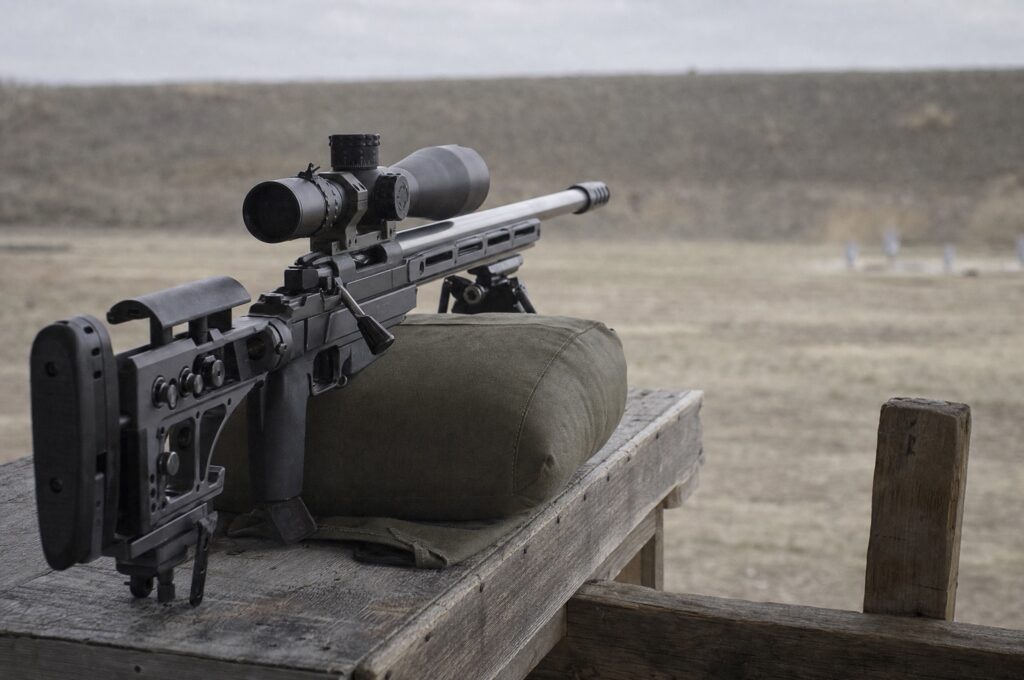
The two rifles in this build are about 30 pounds and about 26 pounds. Thirty is at the extreme end. The historical average was closer to 18 to 22 pounds, and more recently it has crept to 20 to 25.
Weight works because of how little a competition rifle actually moves. In a match you hold it between positions, pick it up, move maybe 20 or 30 feet between stages, and set it back down. How heavy it is to transport does not matter. What matters is whether you can manipulate it on a stage. A lighter rifle is potentially faster to move, and at around 18 pounds you can run a barricade stage quickly.
What the weight buys is stability. Heavier rifles settle better when you are shooting positionally off a bag, and more mass takes more force to move under recoil, so felt recoil drops and follow-up shots stay on target.
The limit is what you can physically handle. Pick a weight you can actually manipulate, which matters more for a smaller-framed shooter, and remember that dropping the rifle is a disqualification. A rifle you cannot maneuver easily becomes a problem getting in and out of positions. Some divisions also impose weight limits, and a rifle like either of these is not set up for those. There is no single rifle that fits every application, and barrel contour and chassis weight are the two choices that follow from deciding what the rifle is for.
Stock or Chassis, and How to Choose?
Chassis systems shoot every bit as well as good stocks, so the choice comes down to how connected you feel to the rifle.
Garrett runs a Foundation Samson he picked up recently, with the Genesis grip, which puts more length between the grip and the trigger. He has larger hands. Dan prefers the Centurion, which is closer, and runs one on his 6 GT. Foundation offers a longer forend and brass or aluminum inserts. The bridge, or hood, is mostly useful against mirage, though rails on it can carry thermal or night vision ahead of the scope.
Foundation stocks are heavy and dense. Shooters describe them as dead when you shoot them, with no ring at all, and that is a large part of the appeal. The stock carries a full length ARCA rail, and 360 Precision’s steel ARCA rail has been popular with older Foundation stocks running brass inserts. Garrett runs a clutch on the rail for his support hand when shooting positional.
Dan’s 6BR wears a Manners TCS. Rather than being inletted for one specific action, it uses a mini chassis, so multiple actions fit. The older design integrated the bottom metal into the mini chassis, so the magazine drops straight in. Newer versions use a V block that takes a traditional bottom metal. His is about five or six years old, from when the TCS first came out.
Between them the two shooters have run nearly every configuration available, including MPA, MDT and ARC. There is no wrong answer in that group. Both prefer a traditional stock, and the reason is ergonomics and how the rifle fits the body rather than any measurable advantage. One of them has tried chassis systems repeatedly and they simply do not feel right to him.
Bipods, Rear Bags, and the Shift Away From Prone
Bipods matter far less in PRS than they used to, because most positional shooting now happens off a rear bag.
Both rifles wear an MDT Ckye-Pod. Dan runs a Gen 1 and has not moved off it. Garrett runs a Gen 2 with a double pull leg and has a Gen 3 on order for the new features. The double pull adds about three inches of height over a single pull, which is the reason to choose it. A triple pull exists and is aimed more at hunters. The pan feature and adjustable leg spread are what make the design worth having.
When they started shooting PRS there was much more emphasis on shooting off a bipod. Now shooters are comfortable enough off bags like a Game Changer that going to the bag is usually the faster call. Setting bipod height, working out where it sits on the forend, and confirming it is configured for the stage all cost time, and with rifles this heavy and this stable on a bag, that time is hard to justify. The bipod now comes out mainly for prone, modified prone, or shooting off a vehicle hood.
Atlas and Harris bipods are still common. An Area 419 ARCA mount lets the bipod slide along the rail and be repositioned, and MDT now includes its own ARCA mount.
Actions: Bolt Throw Angle and Muscle Memory
Neither shooter sees a real performance difference between the major custom actions, so the decision is bolt throw angle and how well you know the action.
Dan runs a Defiance Ruckus and also owns a Defiance Deviant. The Deviant was his original action and he switched when the Ruckus came out. The Deviant was coated afterward and did not run smoothly for a while. It runs smoothly now, but still not as smoothly as the Ruckus, and that is most of the reason he reaches for the Ruckus rifle. Garrett runs an Impact action in a Foundation stock. Impacts have been out a while, and he sees no real performance separation between Impact, Defiance and Lone Peak.
Bolt throw is the real variable. A traditional two-lug 90 degree action has a longer swing on open and close, and the tradeoff for that longer travel is a lighter, smoother lift. A Terminus 60 degree three-lug has a much shorter stroke, but it cocks the firing pin over less travel, so the open and close are heavier. Garrett runs a 75 degree bolt, a two-lug that splits the difference between feel and quickness. Defiance is believed to offer 75 degree bolts now as well. The phrase both shooters use is that smooth is fast.
The part that matters more than any of that is familiarity. Two rifles built to identical specs will still produce a preference for one, and that preference is mental. A broken-in action you know becomes second nature, to the point where you feel through the bolt that a round did not feed. On the clock the mind drops into muscle memory, so the goal is to push as much of the rifle handling into muscle memory as possible and leave your attention for the dial, the hold and the wind. Those are the things the stage was built to test. Time spent sorting out a bad feed or swapping a magazine is time you want to eliminate.
That is also the argument for not changing anything. Dan rebuilds his rifle to the same spec every time, and the build has been essentially unchanged for five years. The only component he swaps is the scope, and only when a new reticle comes out.
Triggers: Weight, Creep, and Finger Discipline
PRS triggers are chosen for a crisp break with no creep, and most competitors run around a pound rather than the lightest setting available.
One rifle runs a TriggerTech Diamond, and has since the Diamond came out. The original adjusted down to four ounces, but almost nobody in PRS uses that range, so the newer version is understood to start at eight ounces instead, and to be better sealed for dusty conditions. The original was not a bad trigger. That rifle runs a single stage with a flat shoe: hit the wall, be there, set the weight where you want it. The other runs a curved single stage at about one pound to one and a quarter.
The case against a very light trigger is that it makes it too easy to break a shot before you are ready. A light trigger does minimize the chance of pulling off target during the pull, which is the argument for it, but many PRS shooters run closer to one to one and a half pounds, and some as much as two, specifically to have a buffer. You want a solid wall so the trigger breaks when you intend it to and not when a finger rests on it. That is also why some shooters prefer a two-stage trigger, where the first stage does the same job.
Creep is the thing worth spending money to avoid. A trigger that reaches the wall and then keeps moving can throw a shot. High-end triggers all give a clean break, and after that the weight is preference. Trigger weight is not worth agonizing over, and trying a heavier setting than you expect to like is worth doing.
There is a handling habit that goes with it. The practice both shooters follow is to leave the bolt open until they are on target, close it, and only then move the finger to the trigger. Trigger finger discipline is one of the first things worth building as a habit for anyone new to the sport.
Optics: Scope, Mount, and Turret Setup
The scope is where most of the money goes and where the two builds diverge most.
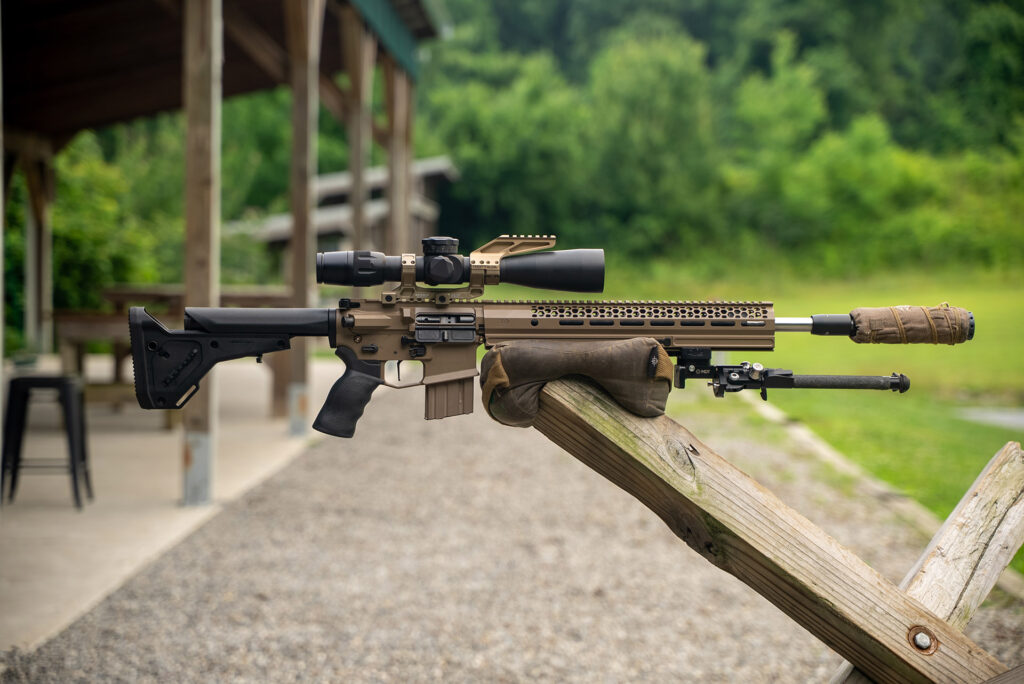
Start with the mount. Both rifles use one-piece mounts, which is what you will find on most PRS rifles. Rings work, but they are less common. Area 419 is the mount Dan names first, and Hawkins makes another well-regarded one. Mounts differ mostly in accessories: some accept a bridge or diving board on top, some have a level built in. Dan runs a level on his and no diving board.
Before a match, everything gets a torque check. An action screw that loosens in transit produces fliers you cannot otherwise explain, and walking into a match with a rifle that suddenly will not group is the worst version of that problem. Witness marks give you a visual check that a screw has turned.
Dan has run Zero Compromise Optics since around 2018, and ZCO is the one component he keeps upgrading. He upgrades for new reticles rather than for the glass, and retired scopes move down onto his other rifles. Two things keep him there. The eye box is very forgiving, which matters most on weak side stages, where a tighter eye box makes finding the picture genuinely hard. And the glass handles mirage about as well as anything out there. A 36mm tube gives a wider field of view than a 30mm tube at the same magnification, so you see more of the target area at the same zoom.
Garrett runs a Minox ZP5 5-25 with a 34mm tube and 15 mil turrets, which he describes as slightly older technology now that many shooters have moved to 36mm. He chose it for glass quality at the price, likes the reticle, and has never had one fail. He previously ran US Optics. Nightforce, Vortex, Kahles and March all make good competition scopes.
Turret spec is worth thinking about before you buy. Dan moved from 15 mil per turn to 10 mil, and it took time to adjust. He liked 15 because he never went above 15 mils at a PRS match, so a second revolution was never a concern. The tradeoff with 10 mil is that the clicks sit closer together, and under time pressure that makes it easier to end up a click or two off. Running two rifles with different turret specs is the harder part of switching. The habit that protects you either way is returning the turret to zero when you leave a stage, which match staff push and may now be a rule.
Nightforce and Vortex offer competition turrets with a dry-erase writable surface, so you can mark your dope directly on the turret. Put a dot at 2.4 mils and label it 2 for the second target, and you stop counting hash marks under time. Garrett instead runs a removable data card on Velcro that he writes on with tape, and flips it out of the way on single-target stages so it is not a distraction. His older ZCO has locking turrets and his newer ones do not, and he believes most ZCO sales have since gone to non-locking. Locking still makes sense for hunting or anywhere you carry the rifle and might knock a turret, but a square range match gives you limited opportunity to do that.
Price is the honest constraint. ZCO, March and Kahles all sit above $4,000, by their estimate. The Minox was around $1,800 to $2,000 on a 50 percent off sale. There are cheaper options that still perform and hold up, and budget determines what you can put into an optic.
Getting Into PRS Without Buying Everything Twice
The most useful thing you can do before spending money is get behind other people’s rifles.
A local one-day match is the easiest way in. They are relaxed enough that you can walk around, meet people, and see equipment in person. Competitors are generally happy to let you handle a rifle, look through an optic, and in a lot of cases shoot a few of their rounds. The etiquette is straightforward: do not ask while someone is set up on a stage, spotting, or prepping to shoot. Ask between stages, after the match, or on a practice day.
Getting behind different pieces of glass is the single best thing you can do before choosing an optic. The sport draws people from all over the country and from every kind of profession, and the camaraderie is real. Both shooters met at matches six to eight years ago.
PRS Rifle Build FAQ
Most PRS rifles now run between 20 and 25 pounds. The historical average was closer to 18 to 22 pounds. The two rifles in this build come in around 26 and 30 pounds, and 30 is at the extreme end. Around 18 pounds you can run a barricade stage quickly, while more weight settles better on a bag and reduces felt recoil.
Twenty-four to 25 inches is the length usually recommended for someone new to the sport. Twenty-five inches is a good middle ground between weight, balance and speed with the BR and Dasher cartridges. Longer barrels buy velocity at roughly 20 feet per second per inch, so a load at 2,800 fps in a 24 inch barrel runs about 2,840 to 2,850 in a 26 inch.
No. A 109 grain 6mm bullet at 2,800 fps will ring steel consistently at 1,200 to 1,400 yards. PRS is not about terminal ballistics, only about landing hits on steel. Bigger cartridges actually make spotting your own misses harder, since in PRS the shooter is also the spotter. A .223 built on a custom bolt action holds 1,000 yards but falls off past that.
It matters for consistency more than for outright accuracy. Button barrels can shoot very well, but they vary more from barrel to barrel, where one prints .45 and the next .35. Cut-rifle barrels are not finicky and take the guesswork out of load development. With one and proper load work including seating depth, quarter inch groups are attainable if you are good enough.
Less than you used to. Most positional shooting now happens off a rear bag like a Game Changer, which is faster than setting bipod height and position for a stage. The bipod comes out mainly for prone, modified prone, or shooting off a vehicle hood. Both of these rifles still carry an MDT Ckye-Pod for those stages.
Most run around one pound to one and a half, and some as much as two. Triggers adjust well below that, down to four or eight ounces depending on the model, but almost nobody in PRS uses that range. The heavier setting gives a buffer so the trigger breaks when you intend it to. What matters more than weight is a crisp break with no creep.
No, though the top-tier glass costs that much. ZCO, March and Kahles all sit above $4,000, by their estimate. One of these rifles runs a Minox ZP5 bought for around $1,800 to $2,000 on sale, with no failures and glass its owner rates highly for the price. Budget determines the choice, and getting behind different scopes at a match is the best way to decide.
Either. Chassis systems from MPA and MDT shoot every bit as well as good stocks, so the decision comes down to how connected you feel to the rifle. Both of these shooters prefer a traditional stock, running a Foundation and a Manners TCS, for ergonomics rather than any measurable advantage. One of them has tried chassis systems repeatedly and they do not feel right to him.
Building a PRS Rifle? Talk to 360 Precision
Most of what is above is preference, but the parts that are not, chambering, barrel fit, and the ability to spin on a new barrel and have the same load shoot the same way, come down to how the rifle was built. If you are planning a build or working out what to change on the one you have, get in touch with 360 Precision and we can talk through the specifics of your setup.