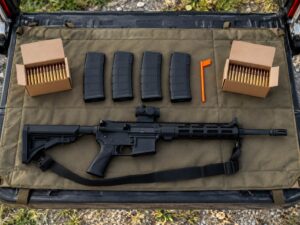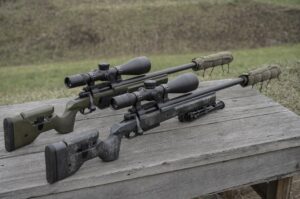
The difference between a single-stage vs two-stage trigger comes down to takeup. A single-stage trigger has none: you touch it, add pressure, and it breaks. A two-stage trigger has a loose first stage that stops at a wall, then a second pull that breaks the shot. Neither is necessarily better. It goes back to what you’re trying to accomplish, and in this episode we also cover what matters when you’re choosing an AR-15.
What Is the Difference Between a Single-Stage and Two-Stage Trigger?
A single-stage trigger has no takeup, while a two-stage trigger has takeup followed by a wall. With a single stage, you touch the trigger, and as soon as you break it, that’s the gun going off. With a two-stage, there’s an initial takeup that’s fairly loose, then it hits a wall, and it takes additional pull through that wall to break the shot.
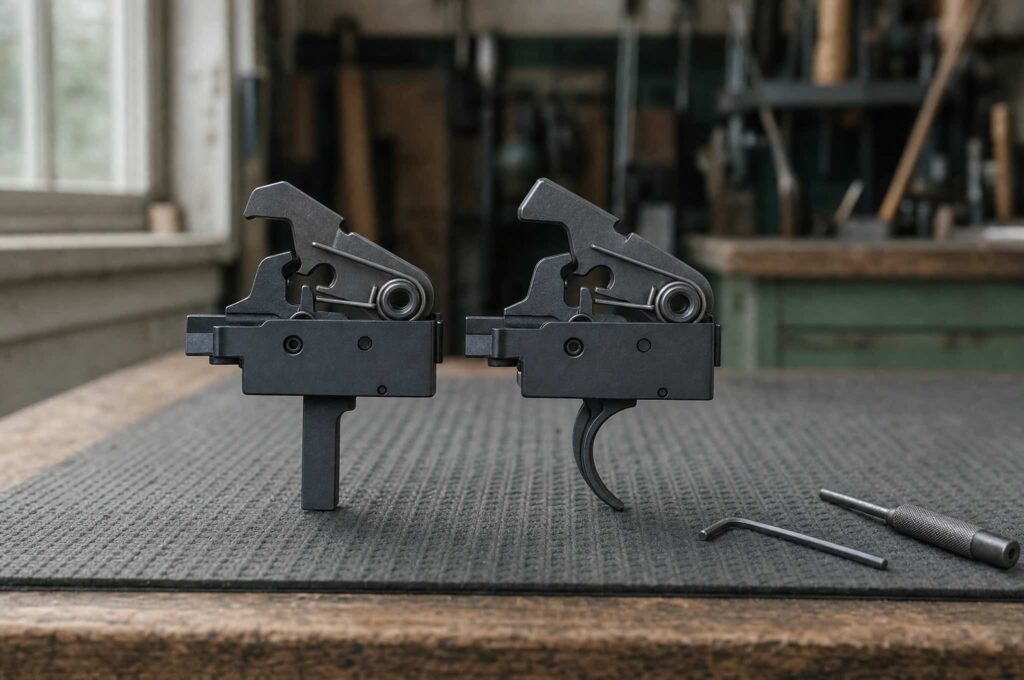
If you’ve shot a pistol, you already know the two-stage feel, since almost all pistols have one.
Where You Find Each One
Most handguns are two-stage, though some 2011s and target-style handguns run a single stage. Once you get into ARs, you start seeing a lot of two-stage triggers. Bolt actions are mainly single stage for the most part, unless you’re putting in aftermarket triggers.
At 360 Precision, all of our semi-auto rifles on the AR platform run a two-stage trigger. A lot of our bolt guns are pretty much single stage. Every now and then a customer wants a two-stage in a bolt gun because their ARs have two-stage triggers and they want to keep the same feel between platforms. One of our gunsmiths summed up a personal preference simply: a big fan of single-stage triggers in bolt guns and two-stage triggers in gas guns.
Why Competition Bolt Guns Run Single-Stage
In competition, one of the biggest reasons for a single stage is that it gives you less ability to pull the shot. That’s also why they’re set lighter. If you’re trying to be ultra precise at long distance, with the target lined up in your reticle, breaking the shot with very little pressure means you put a lot less influence into the rifle before the bullet leaves the barrel.
That’s why most rifles in the competition world (PRS, some NRL, and the 22 matches) run single-stage triggers. A single-stage break is typically very light. It could be 1 to 2 pounds, it can be lighter, it can even be ounces. For most competition bolt guns, 1 to 2 pounds is where you’ll find them.
The Downside: No Wall, No Warning
The downside of a single stage is that it goes off as soon as you touch it and put pressure on it. There’s no feeling for a wall, no setting up on it before you break the shot.
That makes trigger discipline essential. The example from the shop: you rack the bolt, put your finger down on the trigger, the gun goes bang, and you’re DQed. Even 1 to 2 pounds is very light and easy to set off if you don’t have real trigger discipline and aren’t on target before you close the bolt.
Why Shooters Like a Two-Stage
Some shooters like the creep and the wall because it lets them get ready: bring the trigger to the wall, set up, then pull through. A two-stage can be found in a single-action or a double-action firearm.
It also works almost like an extra safety. You can smack it and it isn’t going to go off immediately, because there’s movement before it hits the wall and breaks. On pistols, though, most people care less about the takeup than the reset. The reset pushing back is what lets them reacquire the target and shoot again.
What a Good Two-Stage Trigger Feels Like
A good two-stage trigger has a first stage that’s definable and fluid, then a hard stop at the wall. You feel it, you bring it back, you know exactly when you’ve hit the wall, and then you break it.
Plenty of two-stage triggers don’t feel like that, particularly on a lot of less expensive handguns. The first stage is sloppy and inconsistent, and there’s no hard wall. Those are two-stage triggers, but they’re not good two-stage triggers. Glocks came up as the opposite example: very defined, so you know exactly where the wall is and where it’s going to break.
The Tradeoffs of a Two-Stage
A two-stage trigger is a little slower, because there’s a second step involved. It also potentially puts more influence into the rifle. Even so, it comes down to personal preference.
Trigger Weight, Shoe Shape, and Personal Preference
Trigger weights vary on both types. On a two-stage, the first stage could be 2 pounds and the second could be 3 or 3.5 pounds. Single-stage triggers can be set to different weights too, if they’re adjustable.
There’s a lot of personal preference in all of this, right down to the trigger shoe. One of our gunsmiths always runs a curved single-stage trigger in a competition bolt action and a flat two-stage trigger in an AR. It’s not about liking one trigger over the other. It’s what feels comfortable for that environment and for what you’re doing.
That’s the real answer to single-stage vs two-stage: pick the trigger you feel most comfortable with and work best with. If you can try both, the gunsmiths’ suggestion is to feel the difference for yourself, because that’s how you’ll understand which one you want. As the host put it, everything about firearms is very personal, from fit to comfort to budget.
Why Is the AR-15 So Popular?
ARs are popular because they’re easy to handle, easy to use, and can be set up so many different ways. They’re basically Legos for adults. You can set them up short or long, in different calibers, on small frames or large frames.
They’re also low recoil and very comfortable, which makes them very easy for new shooters to handle.
What to Look for in an AR-15
The AR platform is reliable and modular, which means there are a lot of choices to make. Here’s how our gunsmiths think through barrel, gas system, bolt, trigger, weight, optics and controls.
Barrel Length: Why 16 Inches Is the Sweet Spot
Sixteen inches is the sweet spot for an AR barrel. In the gunsmiths’ words, the reason is more about laws than the rifle: a 16-inch barrel means you don’t have to worry about it being a short-barreled rifle. They didn’t go into the many laws and exceptions beyond that.
Sixteen inches is still a very maneuverable length, and it gets the bullet close to its velocity potential. In .223 you’re not getting a full powder burn, but you’re getting a fair amount of it, so you get good velocity. It’s good for short range and works for a decent amount of long range too: easily 600 to 700 yards while still making very consistent shots.
There’s a point where you can go too short and start losing performance and enjoyability. A 10.5-inch .223 with a brake on it is concussive, loud, and throws a big fireball. Shorter barrels are nice for self-defense, but one of our gunsmiths says that, personally, going under 12.5 inches would probably mean switching to 300 Blackout.
Barrel Contour and Why the Recon Is Dimpled
Contour is the thickness and shape of the barrel’s exterior. The right contour depends on what you’re trying to do.
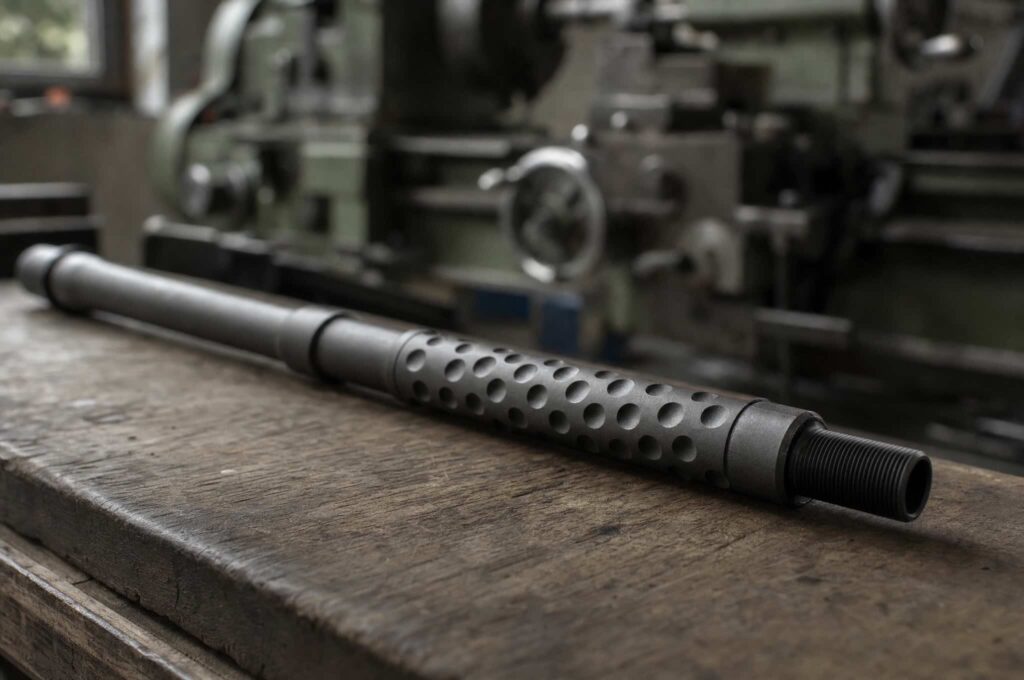
On the Recon rifle, we use a heavier-contour 16-inch barrel and then dimple it. Dimpling lessens some of the barrel’s weight, and it helps with heat dissipation because it adds surface area. The heavier contour is there for accuracy: we typically see improved accuracy from a heavier contour because it cuts down on harmonics. A super lightweight pencil-profile barrel, by contrast, whips a lot.
Gas System: Mid-Length, Carbine, and the Adjustable Gas Block
A 16-inch barrel typically runs a mid-length gas system, which gives you nicer, smoother recoil than a carbine-length system. That smoother operation also leads to longer life for the platform. A lot of shooters like carbine gas for hard duty use because it’s overgassed and will function super dirty, but that excess wear and extra force brings down the life of parts like bolt carrier groups and springs.
Whatever the length, you want the rifle properly gassed. We put an adjustable gas block on our rifles, which lets you adjust how much force comes back on the bolt. If you decide to add a suppressor, you can adjust for the change in back pressure. Different ammunition can produce different back pressure too, and an adjustable gas block lets you tune for that.
Get it wrong in either direction and you’ll know. An overgassed rifle blows back into your face, and you’re breathing in toxic fumes, which isn’t a pleasant shooting experience. An undergassed rifle won’t cycle properly. It might cycle when it’s clean, but once it gets dirty it short-strokes and doesn’t lock open on the last round.
With more people shooting suppressed, this is worth taking into consideration, since not every AR performs the same way. The adjustable gas block is especially big on 300 Blackout, where you might be shooting supersonic or subsonic ammunition.
The Bolt Carrier Group Takes the Abuse
The bolt carrier group is another big piece to consider, and it’s easy to change out: you can drop a bolt and swap it. Every time the rifle fires, the bolt eats that force. It gets driven back, hits the buffer, returns, and slams back into battery.
Coatings matter. There are many coatings available, and the better the coating, the longer the BCG will run without being cleaned. With a good lubricity coating you can run it dirtier. With a standard coating, maybe just phosphate, you’ll potentially have to clean it more often.
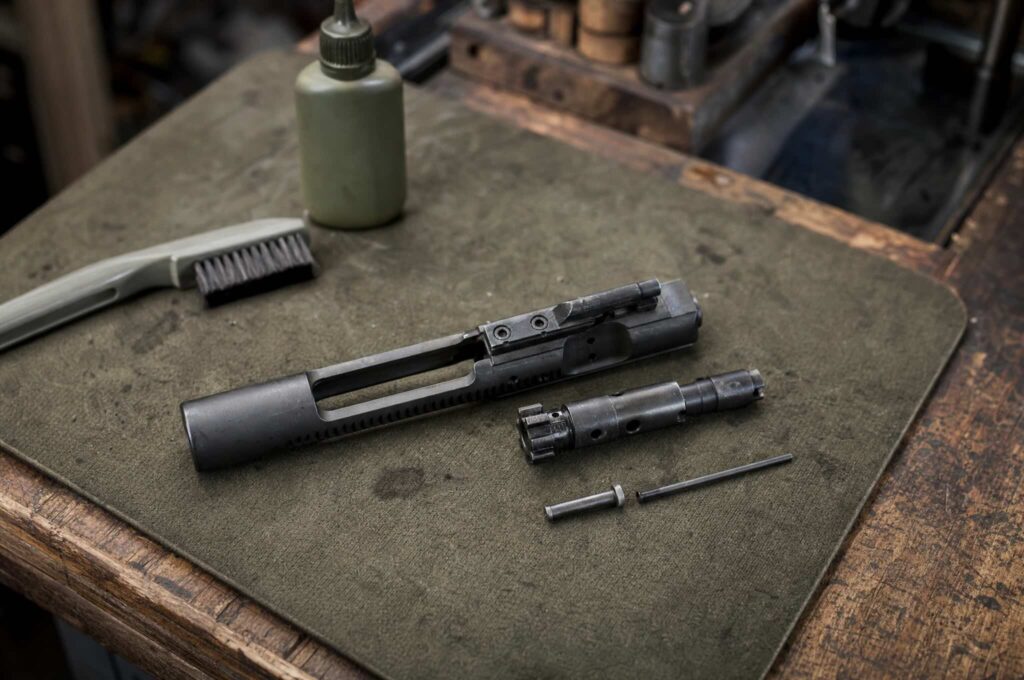
If you shoot a lot, thousands of rounds a year, the steel the bolt is made from matters too. A lower-end bolt isn’t going to last as long as a higher-end one. We use 9310 steel as opposed to Carpenter 158, and some lower-priced bolts use chrome moly. We have seen bolts fail at high round counts. The host summed it up as the difference between a $450 rifle and a $1,200 rifle.
You also want a rifle that runs across different bullet weights. You might shoot 55 grain for plinking and 75 or 77 grain for long range, and 77 grain costs more than 55. Switching between them means rezeroing, but the rifle should keep functioning on all of them.
AR Triggers and Why Reset Matters
On an AR, the right trigger depends on what the rifle is for. A competition rifle may call for a lighter trigger. You might want a very positive reset or a really light, short one. A duty gun may call for a 4.5-pound or heavier pull.
Reset is how far you release the trigger before it resets and can fire again. You’re not letting it out all the way. You control the pull through the break, release to the reset point, and pull again. Feeling that reset helps with follow-up shots.
That’s why one of our gunsmiths isn’t a big fan of single-stage triggers on an AR. There is a reset, but it’s so slight you can’t really feel it, so you don’t know when it’s reset. In that gunsmith’s view, it’s even easier to shoot a two-stage fast than a single-stage fast. Not because of the mechanics, but because your mind is looking for the reset, and without feeling it you might not push the trigger far enough out, or you go too far out. When reacquiring a target, the last thing you want is to be thinking about the trigger.
That’s why we switched to the trigger we use in our rifles now: it has a very positive reset. You feel it, you hear it, and you know it reset instead of guessing. The host shoots better with a flat-faced trigger on an AR, because a flat face feels like a straight pull back, while a curved one makes their brain try to compensate. For the host, feeling the reset is extremely important.
Weight and Balance
ARs generally come in somewhere around 6 to 7 pounds unloaded, without optics. The heavier the gun, the less felt recoil.
If you have to carry a rifle all day, hunting for example, a lighter rifle makes sense. If you’re going to sit at a bench and plink, heavier is better, because it’s a much more pleasant shooting experience all day long. A heavy enough AR in .223 is like shooting a 22.
In competition, balance matters. A balanced rifle helps you move between positions and reacquire the target. Adding a suppressor and other gear toward the muzzle can make a rifle front heavy, and since different stocks weigh different amounts, you can sometimes offset that with a stock.
Optics: Red Dot, Magnifier, or LPVO
Magnified optics and LPVOs, red dots, a red dot with a magnifier, and iron sights are all good options. It depends on what you’re using the rifle for.
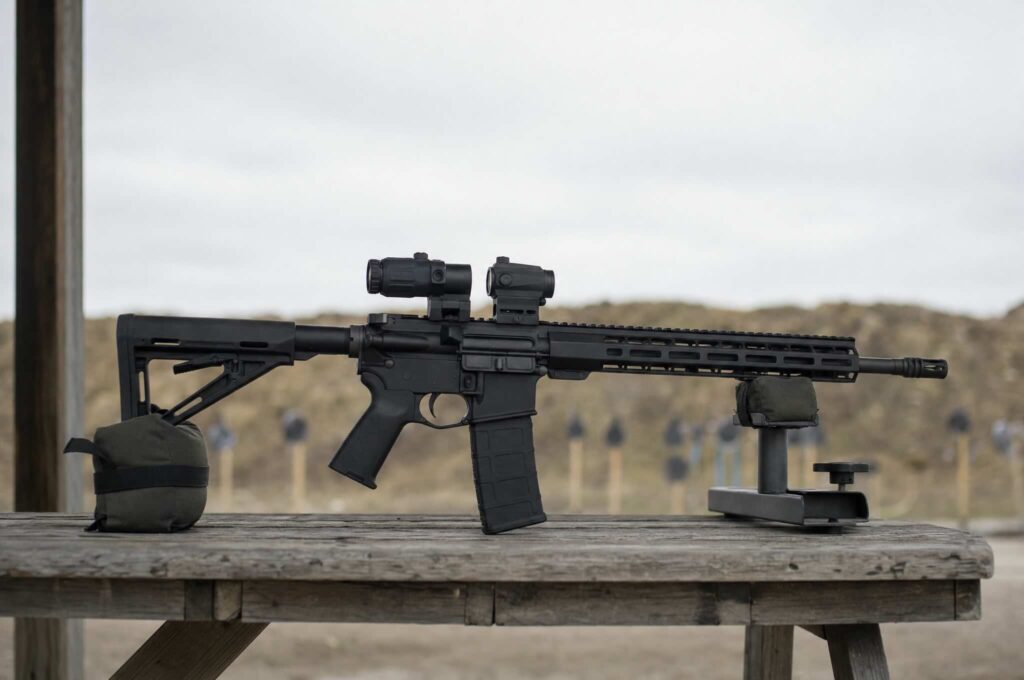
Optics add weight. An LPVO or scope, plus a cantilever mount, weighs a lot more than a red dot. If you’re shooting 500 yards and out, a scope is almost a must to do it accurately and consistently. If you’re only shooting 100 to 200 yards, a red dot is perfectly fine, and we’ve shot ARs out to 500 yards with just red dots. If most of your shooting is 150 yards and in but you occasionally reach out to 300 or 400, a magnifier is a great option: flip it up and you have 3 power.
Overbuilding is the trap. A 5-27 scope on an AR is unnecessary unless you’re chasing the smallest possible group at 100 yards. It’s your money, and you can spend it however you want, but build the rifle for its purpose.
Handguards and Ambidextrous Controls
Handguards are personal. Some shooters find one too thin, others too thick, and it depends on what you’re mounting: a laser, a flashlight, or a suppressor that sits inside the handguard. There’s no one-size-fits-all. We try to make ours as versatile as possible. The gunsmiths point to M-LOCK or Picatinny as the thing to look for, since a standard interface lets you attach what you want, and to knowing which attachments you plan to run.
Braxton handled the ambidextrous controls. Our rifles have an ambi safety, an ambi charging handle, and an ambi bolt drop. The bolt drop is the big one in competition. Behind a barricade with the bolt locked to the rear, you don’t want to take your hand off the rifle to drop the bolt from the left side. You just reach up with your trigger finger, hit the paddle, and move back down to the trigger without breaking your grip. That helps with target acquisition, and left-handed shooters don’t have to work the controls from the other side of the gun. In Braxton’s view, full ambi controls are almost a must on an AR nowadays.
How Accurate Is an AR-15?
ARs are generally a fairly accurate platform, but it depends on whether you’re running direct impingement or a piston. In general, piston-driven firearms are a little less accurate than direct impingement guns like the ones we build.
The reason is harmonics. A piston system adds a piston that physically moves back and forth, and anything that moves while connected to the barrel negatively affects harmonics, which negatively affects accuracy. On a SCAR-style platform, a rifle that shoots 2 MOA is considered excellent. On the Evolution competition rifle, the gunsmiths’ stated expectation is 3/4 MOA or better, which is why a piston isn’t a good option for that build. Something new is coming for the EVO, so stay tuned.
Every AR is a balance between precision and reliability. Make a rifle too precise, with tolerances too tight, and it stops functioning as soon as it gets dirty. Make it too reliable and it’s sloppy: it runs no matter how dirty it gets, but there’s no accuracy. We try to play in the middle.
We fire every rifle before it leaves the shop for quality control. Each one is tuned to verify it functions properly and that the buffer weight is right for that rifle. The result is a very consistent ejection pattern, basically a pile of brass within about 2 feet, not one going this way and one going that way.
What People Get Wrong About ARs
The biggest misconception is that the AR is a scary assault rifle. In the gunsmiths’ view, it’s a semi-auto modern sporting rifle, not a weapon of war the way some politicians try to make it out to be.
It also isn’t the hole-blasting cartridge it’s portrayed as on TV. In the gunsmiths’ words, .223 is a caliber that isn’t legal to hunt large game in most states, because it’s considered unethical for lack of stopping power.
The Bigger Picture
The AR is so popular because it’s very reliable and very modular. You can put so many different things on it. Shoulder support lets you be accurate in a way that’s very hard with a pistol, especially at any distance. It stays fairly light depending on how you configure it, and it can be set up for short and long range, in calibers from pistol rounds all the way up to 6 ARC and 22 ARC. It’s easy to handle and great for beginners to learn on.
The trigger question and the AR question end up in the same place. Neither type of trigger is necessarily better than the other, and there’s no single right AR. The right setup is the one that fits what you’re doing and feels right in your hands.
Ask a Gunsmith FAQ
A single-stage trigger has no takeup: you touch it, and as soon as you break it, the gun goes off. A two-stage trigger has a fairly loose initial takeup that stops at a wall, then additional pull through that wall to break the shot. Almost all pistols are two-stage, so anyone who has shot one already knows the feel.
Neither one is necessarily better. It depends on what you’re trying to accomplish, how you use the gun, and how you want it to feel. One of our gunsmiths prefers single-stage triggers in bolt guns and two-stage triggers in gas guns, and the practical answer is to pick the trigger you’re most comfortable with and work best with.
A single-stage trigger gives you less ability to pull the shot, which is why competition triggers are set light, often 1 to 2 pounds. When you’re ultra precise at long distance, breaking the shot with very little pressure puts much less influence into the rifle before the bullet leaves the barrel. That’s why most PRS, some NRL, and 22 match rifles run them.
It’s personal preference. One of our gunsmiths runs a straight trigger on an AR and a curved trigger on a bolt action. The host shoots better with a flat-faced trigger on an AR, because a flat face feels like a straight pull back, while a curved one makes the brain try to compensate.
Reset is how far you release the trigger before it resets and can fire again. You don’t let it out all the way. Feeling the reset helps with follow-up shots, which is why one of our gunsmiths doesn’t like single-stage triggers on an AR: the reset is so slight you don’t know when it’s happened.
Sixteen inches is the sweet spot. It’s still very maneuverable, it gets the bullet close to its velocity potential, and it works from short range out to 600 or 700 yards with very consistent shots. Going too short costs performance, and one of our gunsmiths says that, personally, going under 12.5 inches would probably mean switching to 300 Blackout.
In general, yes. A piston physically moves back and forth, and anything moving that’s connected to the barrel negatively affects harmonics, which negatively affects accuracy. Piston-driven rifles are a little less accurate than direct impingement rifles in general, and direct impingement is what 360 Precision builds.
Not always. A red dot is perfectly fine at 100 to 200 yards, and we’ve shot ARs out to 500 yards with red dots. If you occasionally reach out to 300 or 400, a flip-up 3 power magnifier is a great option. If you’re shooting 500 yards and beyond, a scope is almost a must to do it accurately and consistently.
Have a Gunsmith Question of Your Own?
Ask the Gunsmith runs on your questions, and the more you send, the more we’ll keep trying to answer. Leave one in the comments on YouTube, message us on social media, or send us your question directly. If you’re ready to buy, the host’s on-air suggestion was Tanner, a local dealer, or you can use our dealer locator to find one near you.
Related Reading
- Your Gunsmith Questions, Answered Straight
- Wildcat Cartridges, the Best PRS Caliber, and How We Accurize a Rifle: Ask a Gunsmith
- What Goes Into a PRS Rifle Build
- Inside the NRA ARC Challenge
Everything above reflects the personal setups and opinions of the gunsmiths in this video and is provided for general information only. It is not instruction, and it is not a substitute for safe firearm handling, the rules of your range, or the rulebook of the match you are shooting. Always confirm the legal status of suppressors and any other regulated component in your jurisdiction.