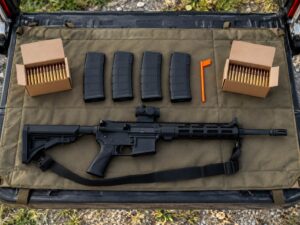
There is a particular kind of person who builds a shooting range in their basement for a seven-year-old, complete with little army men and soda cans lined up as targets. Dave Wollman’s father was that kind of person. And from those early days with a pellet gun in suburban Pennsylvania, a lifelong passion for firearms, and the precision behind them, was set in motion.
Today, Dave serves as the president of Laugo Arms USA, the exclusive U.S. importer, distributor, and customer service arm for the Laugo Arms Alien pistol platform. He recently sat down on the Accuracy Matters podcast to talk about everything from growing up behind a gun to the engineering marvel that is the Alien lineup, and how the competition shooting community shaped both his career and his closest friendships.
From Pellet Guns in the Basement to Competition Stages
Dave’s introduction to firearms started early. By the time he was 11 or 12, his father had upgraded him from that first pellet gun to a .22 rifle. Scouting followed, bringing rimfire competitions and merit badges. But it was the family property in northern Pennsylvania where Dave really came into his own, sneaking off into the woods with his .22, setting up shotgun shells on tree branches, and building his own dynamic shooting courses through the timber.
“I’d create my own little dynamic shooting range that I could walk through the woods and have targets from anywhere from 10 yards to 30 yards,” Dave recalls.
That hands-on, self-taught approach to dynamic shooting would prove prescient. By his early shooting years, Dave had already been practicing the kind of action-oriented shooting that would later define multi-gun competition. He just didn’t know it yet.
What makes Dave’s story relatable to so many in the firearms community is his enthusiasm for shooting across multiple disciplines. Pistol, rifle, shotgun, sporting clays, carbine work, long-range bolt guns. He’s touched all of it. And he firmly believes that cross-training across platforms is what keeps a shooter progressing rather than plateauing.
“If all you do is shoot one gun, at some point you’re going to plateau,” he says. “Whereas if you have that cross-section of shooting a little bit of everything, you can switch it up. It keeps it fun, and it keeps you growing.”
Falling Into Competition Shooting by Accident
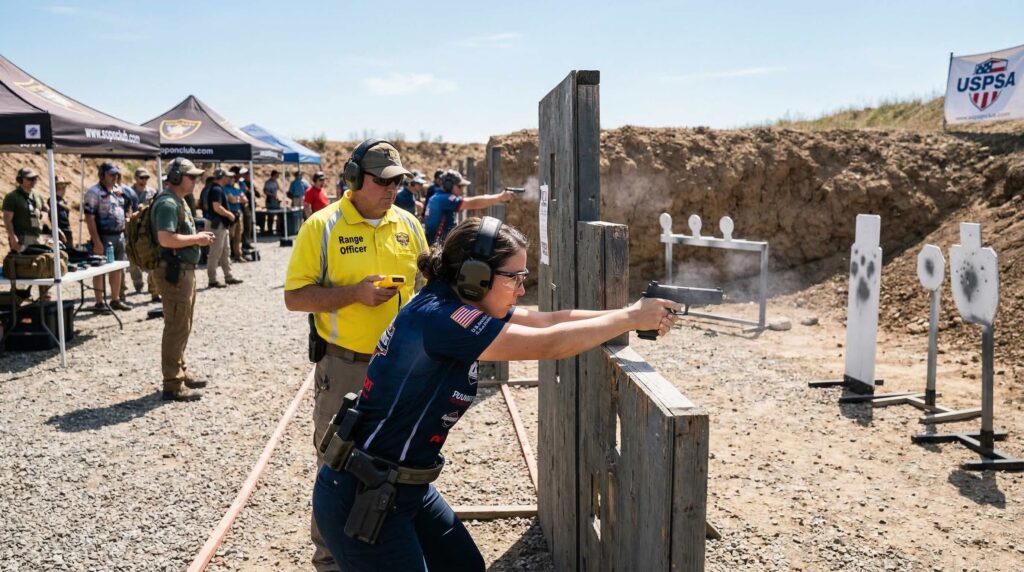
Dave didn’t set out to become a competitive shooter. Around 2015 or 2016, he was picking up a shotgun at a local FFL when someone mentioned that Langhorne Rod and Gun Club in Holland, Pennsylvania was hosting a multi-gun event that weekend. Dave had no idea the club even existed, let alone that they ran matches open to the public.
He showed up with a pump-action Remington 870, a cobbled-together AR-15 “Franken build,” and whatever pistol he was carrying at the time. If you’ve ever wondered what experienced competitors actually carry in their ruck sack on match day, it’s a far cry from Dave’s first loadout. But what he found was the thing that hooks so many new competitors: the community.
“Almost without exception, everybody is just so welcoming,” Dave says. “It was, ‘Hey, try my shell caddies,’ or ‘Try my rifle sling,’ or ‘Here’s a tip for positional shooting.’ That hook got sunk deep on that first match.”
From that single club match, Dave went on to shoot every monthly event for the rest of the year, then expanded to 3-Gun Nation events, UML matches, and eventually USPSA to sharpen his pistol skills. By 2022 and 2023, he was shooting 20 to 30 matches a year.
What stands out most in Dave’s telling is the social fabric of competitive shooting. His current best friend and best man at his wedding? They met at one of those early multi-gun club matches. It’s a story that repeats itself across the competition shooting world, with people bonding over shared passions that extend well beyond firearms into watches, cars, cigars, and whiskey.
“If you’re into guns, you’re probably a gear guy. You’re probably going to be into watches or cars or cigars or good whiskeys,” Dave observes. “There’s usually a lot of overlap in hobbies and passions, and people bond over that very quickly.”
Of course, that welcoming culture only works if everyone respects the unwritten rules. For a look at the etiquette that keeps match culture strong, it’s worth understanding what earns respect at a match and what doesn’t.
The Value of Diversified Training
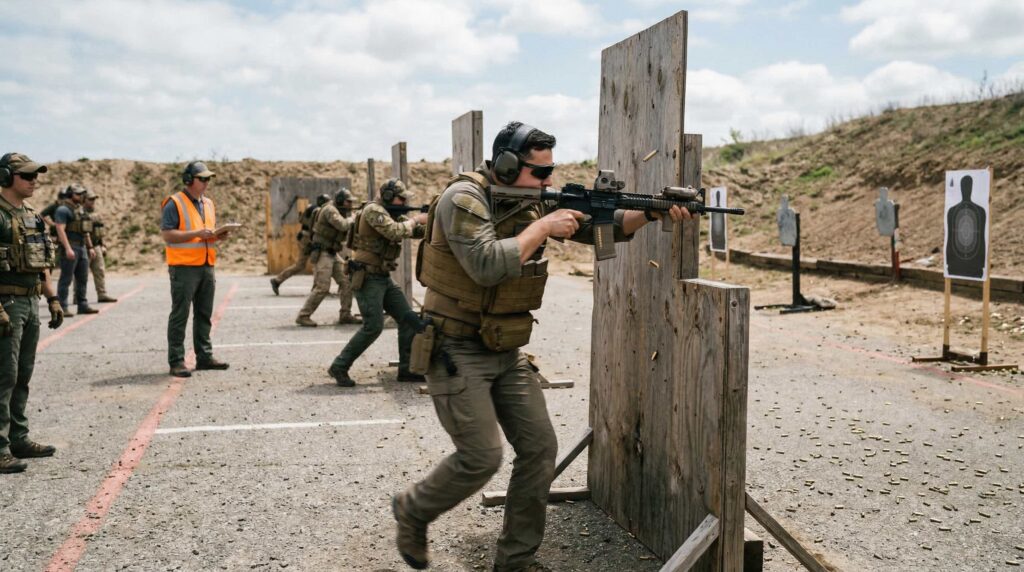
One of the more practical takeaways from Dave’s conversation is his strong advocacy for training across disciplines. He’s quick to warn against what he calls “competitional complacency,” the tendency for competition shooters to develop habits that work well on a one-way range but could become liabilities in real-world scenarios.
“If all you do is run as fast as you can and shoot at big pieces of paper, your accuracy is going to suffer,” he says. “Your split-second thinking is going to suffer because all you’re doing is executing a stage plan.”
Dave has taken courses from outfits like Fieldcraft Survival, and he gravitates toward self-defense and tactical-oriented training to keep his fundamentals sharp. His reasoning is straightforward: if you carry a firearm daily, you have a responsibility to be an asset, not a liability. Competition skills are valuable, but they need to be balanced with practical defensive proficiency.
He shared a cautionary story from a contact in the security world: a police officer had been trained that whenever he experienced a malfunction, he was to set his firearm down and raise his hand. It was a range safety protocol. When he encountered a malfunction during an actual incident, that was exactly what his muscle memory told him to do.
“If you train just one particular way, that’s all you’re going to know,” Dave warns. The message is clear. Diversify your training, and you’ll be a more well-rounded, capable shooter. For those just getting started, Joe Gentile’s breakdown of the biggest mistakes new shooters make is a solid primer on building good habits early.
The Precision Connection: Firearms, Watches, and Engineering
Before landing in the firearms industry, Dave spent time in the watch industry. It was a detour that, in retrospect, makes perfect sense. The same appreciation for precision engineering that draws people to high-end firearms is the same thing that makes a Swiss watch movement fascinating.
“You just have an appreciation for what mankind has become capable of manufacturing,” Dave says. “It’s not just engineering. It’s the ability to then actually craft that with your hands.”
He draws a direct line between the worlds of watches, firearms, and high-performance automobiles. In each case, there’s a blend of cutting-edge technology and hands-on craftsmanship that produces something greater than the sum of its parts. It’s a mindset that links precision rifle work to the art of finishing a watch movement by hand.
But Dave ultimately realized he wanted to work in an industry where the product and the community resonated at a deeper level. “I woke up one morning and said, ‘Man, I love watches, but I’m not a watch industry guy,'” he recalls. That clarity led him to firearms, and eventually to Laugo Arms USA.
Understanding the Laugo Alien Platform: Three Pistols, One Philosophy
At the core of Dave’s work with Laugo Arms USA is the Laugo Arms Alien pistol platform, a lineup that currently includes three distinct models, each built on the same innovative foundation but tuned for different applications.
The Original Alien
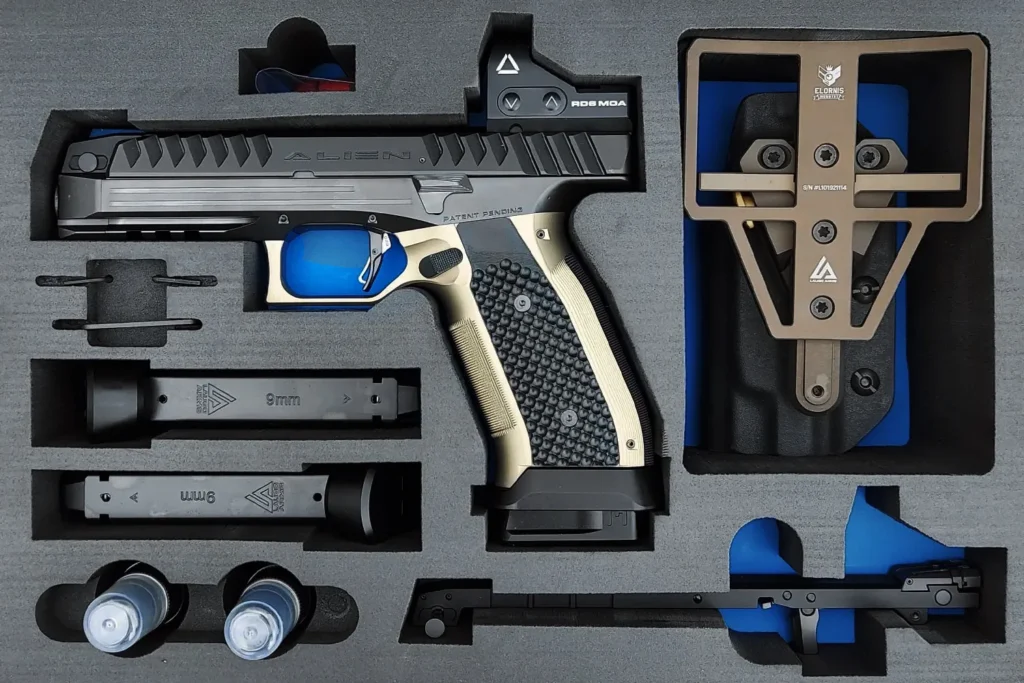
The Laugo Alien was the pistol that started it all. Launched in Europe around 2017 and arriving in the U.S. market in the winter of 2019-2020, it was purpose-built for competition shooting. The Alien introduced several features that were genuinely novel in the handgun world: a fixed barrel with a gas-delayed blowback operating system, an ultra-low bore axis, and most notably, a non-reciprocating optic rail. The level of precision required to achieve this kind of performance starts at the manufacturing level, much like the steps involved in accurizing a precision rifle.
On most pistols, the red dot optic sits on top of the slide and reciprocates back and forth with every shot fired. On the original Alien, only the sides of the slide move. The top rail stays fixed. The result is a stationary optic that behaves more like a dot on a rifle than a typical pistol optic.
“There’s no return to zero because there’s no loss of zero,” Dave explains. For competition shooters chasing every fractional advantage in speed and accuracy, this was a game-changer.
The original Alien featured a swept-back European grip angle (think Glock) and a 1911-style grip panel design with side-mounted panels and two grip screws. It remains in production and continues to sell well.
The Alien Creator Evolution
Launched at Shot Show 2024, the Creator Evolution was designed specifically with the American shooter in mind. Under the hood, it shares the same operating system and many interchangeable components with the original Alien. The key difference is in the grip.
The Creator features a more upright grip angle, a direct response to feedback from U.S. shooters who’d spent their careers drawing and presenting firearms with 1911 or SIG P320-style angles. The result is a more natural point of aim for American shooters, meaning less time hunting for the dot on the draw.
But the real story of the Creator is in its modularity. With a single screw on the back of the magwell, the entire grip assembly (panels, backstrap, and magwell) comes off. Different sizes, textures, materials, and colors are available, allowing shooters to build the pistol around their hand rather than adapting their grip to the gun. It’s why Laugo calls it the “Creator.” You create the configuration that works for you.
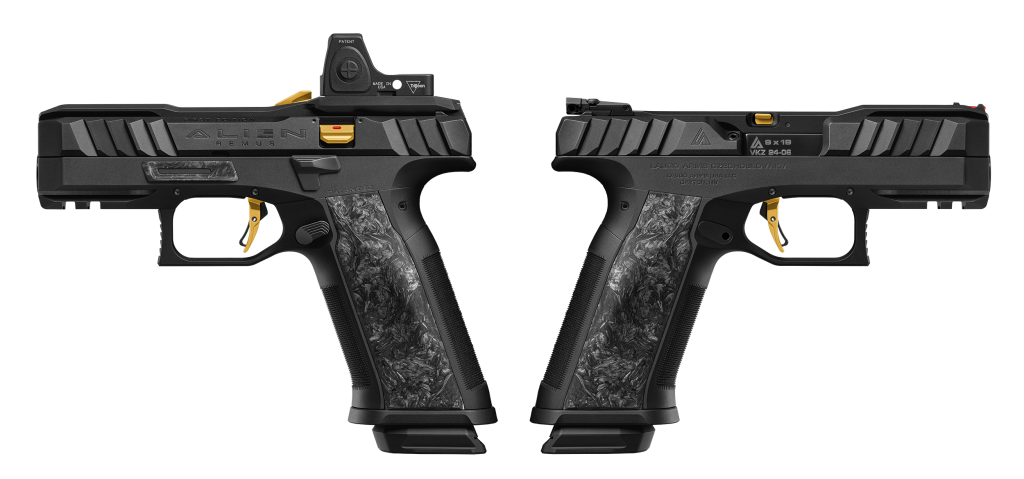
The Alien Remus: The Carry Gun the Market Demanded
The Remus is the newest addition to the family, launched at Shot Show 2025. It answers the question that Laugo Arms USA had been fielding for years: “When are you going to make a carry gun?”
The logic is simple. If you’re a competition shooter sending tens of thousands of rounds downrange through your Alien every month, you’ve built deep muscle memory around that platform. The trigger feel, the natural point of aim, the way it sits in your hand. Switching to a completely different pistol for everyday carry means abandoning all of that proficiency when your life may depend on it.
The Remus is exactly the same as the Creator from the waist down. All Creator grip panels, mag wells, and backstraps are cross-compatible. The difference is in the upper: the barrel is an inch shorter, and the gun incorporates features specifically designed for concealed carry.
The standout innovation is the Push-To-Rack (PTR) system. The original Alien’s fixed optic was fantastic for competition but presented a challenge for defensive use. You couldn’t rack the slide off the optic to clear malfunctions. The Remus solves this with a latch in front of the optic that, when engaged, turns the optic mount into a non-reciprocating charging handle. Press the latch, rack off the optic, and the slide cycles. When firing, the optic remains stationary. It’s the best of both worlds.
“They not only listened to the U.S. shooter community, they checked all of the boxes,” Dave says of the Remus development.
Limited Editions, Special Editions, and the Gemini Kit
Laugo Arms USA offers more than just the core production lineup. Dave drew an important distinction between special editions and limited editions during the podcast.
Special editions are produced in smaller batches, maybe 25 or 50 units in a run, but they aren’t serialized to a fixed number. They may or may not be produced again in the future.
Limited editions, on the other hand, are serialized (e.g., “1 of 500” or “1 of 100”) and will never be produced again in that exact configuration. For buyers investing in a limited edition, that permanence matters.
The newest limited release is the Gemini kit, unveiled at Shot Show 2026. It’s a matched pair of Remis pistols, one left-handed and one right-handed, with matching serial numbers, titanium nitride magazines, custom carbon fiber grip panels, and a machined aluminum display case. Only 50 kits were produced worldwide, with 25 allocated for the U.S. market, at an MSRP of $30,000.
The left-handed Remis itself is significant. It’s a fully mirrored pistol with left-side ejection, not just an ambidextrous model with reversible controls. It represents a genuine commitment to serving left-handed shooters, a demographic that is routinely underserved in the firearms market.
The Dealer Network and Customer Experience
Dave spent time in a previous career in distribution, and he carries hard-won lessons about the importance of supporting dealers. At Laugo Arms USA, the philosophy is clear: push sales back to the dealer whenever possible.
“If somebody reaches out to us considering a purchase, we will always start with, ‘It looks like you’ve got a dealer about 20 minutes from you. Go talk with them,'” Dave explains. “They are our lifeblood.”
With over 200 dealers nationwide, Laugo Arms USA balances accessibility with dealer support. If a customer lives in a remote area, say rural Nebraska, 200 miles from the nearest dealer, Laugo Arms will handle the sale directly. But the default is always to route business through the dealer network.
On the customer experience side, every Alien pistol carries an on-paper warranty of 30,000 rounds and two years, but Dave says they rarely turn down a warranty claim. “If it’s something we can fix for you and you’re a good customer, we are here to take care of you.”
The team also invests heavily in customer education through their online Knowledge Center, recognizing that the Alien platform is genuinely different from anything else on the market. Videos cover everything from unique features to maximizing the ownership experience.
Tariffs, Pricing, and Navigating Import Challenges
As a U.S. importer of Czech-manufactured firearms, Laugo Arms USA sits squarely in the crosshairs of trade policy. Dave was candid about the impact of EU tariffs, which jumped from 3% to 15% last summer. That’s a significant hit on a product line that already sits at the premium end of the market.
Laugo Arms absorbed as much of the increase as possible internally, raising retail prices only about 5-6% for 2026 despite a 12% tariff increase. “We did as much as we could to insulate our customer base from that,” Dave says.
With over 200 dealers to serve, price stability matters. “You can’t be changing your prices every month,” he notes. “We have to create that consistency in the marketplace, even when on the back end it’s a lot of instability.”
The tariff landscape continues to shift, with recent discussions about potential rollbacks adding another layer of uncertainty. It’s one more variable in an already complex import business.
The State of the Firearms Industry in 2026
Dave offered a thoughtful read on where the industry stands heading into 2026. The COVID-era boom, fueled by civil unrest, disposable income, and new gun owners seeking security, has given way to a correction. Many of those pandemic-era firearms have hit the used market, and the “Trump slump” (reduced panic buying under a Republican administration) compounded the slowdown.
But Dave sees signs of stabilization. Background check numbers are rising again. Firearm sales are returning to pre-COVID levels, which he considers a healthy baseline for the industry.
For the high-end pistol market specifically, the timing is favorable. The 2011 market has normalized the idea of spending $5,000 or more on a handgun. Competition shooters who routinely invest $8,000 to $12,000 in custom 2011 builds find the Alien’s $5,000-$6,000 price point surprisingly accessible.
“It’s like being able to buy a Ferrari for Porsche pricing,” Dave says.
Competition and Innovation: Staying Ahead of the Curve
For the first time in years, other manufacturers are beginning to challenge the Alien’s unique position in the market. New designs featuring low bore axis configurations and innovative operating systems appeared at Shot Show 2026, and Dave welcomes the competition.
“For the last few years, there hasn’t been much that’s come out to try to compete with the Alien,” he acknowledges. “But it’s cool because now it’s pushing us again to say, ‘What’s going to be the next iteration, the next evolution?'”
Dave credits the factory in the Czech Republic with a level of engineering creativity that consistently surprises him. The factory blends state-of-the-art CNC technology with old-world European craftsmanship. The team consists of 50 to 60 employees, each specializing in a single task. If the person who puts the perfect surface finish on a sear isn’t there that week, that part doesn’t get made.
It’s a manufacturing philosophy more commonly associated with Swiss watchmaking than firearms production, and it’s a key reason the Alien platform feels different in hand and in performance. For a deeper look at how different manufacturing methods shape firearm components, the distinction between machined and forged production is a good starting point.
Laugo Arms USA visits the Czech factory once or twice a year to share market intelligence: trends, gaps, and what U.S. shooters are asking for. The Creator and Remis exist specifically because the factory listened to that feedback. And with new competition emerging, the pressure to innovate is only increasing.
Entrepreneurship, Burnout, and Finding Your Passion
The conversation took a personal turn when Dave and the host discussed the realities of entrepreneurship. Dave has started multiple businesses, not all of which succeeded, including a nine-year run with a media production and marketing company that ultimately ended in burnout rather than failure.
“You learn so much more from the businesses that don’t make it than from the ones that succeed,” Dave says. “There are so many more pitfalls and things you learn to avoid than you learn to do.”
Now as president of Laugo Arms USA, a co-founder of 9×19, and a new father with a six-and-a-half-month-old at home, Dave’s match count has dropped from 20-30 per year to about five. But he’s found a different kind of fulfillment in building the business, running demo events, and introducing new shooters to the Alien platform.
“Even if I’m not shooting, if I’m still out at a match surrounded by the guys I shoot with, seeing new people get into the sport, putting new shooters onto our guns, for me that’s every bit as rewarding as shooting the match myself.”
Where to Follow Laugo Arms USA
For those interested in the Alien platform, Dave recommends:
- Instagram: @LaugoArms and @LaugoArmsUSA
- Website: laugoarmsusa.com, including the Knowledge Center for in-depth product videos