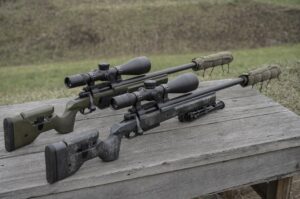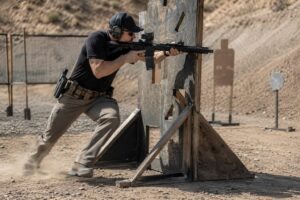
Walk into almost any gun shop in the country, and you will hear some version of this conversation. A new shooter wants to know what caliber to buy. Someone behind the counter – or another customer – leans in and says something like “go bigger.” Bigger caliber, bigger bullet, more power.
The 360 Precision gunsmiths have been hearing this question for years. In this episode of their Ask the Gunsmith series, they finally put the answer on record – and it is not what a lot of people want to hear.
Bigger is not always better. In a lot of cases, it can actually make you worse.
The Real Question Is Not “What Is the Biggest?” It Is “What Is the Purpose?”
The gunsmiths at 360 Precision are direct about this: the wrong question is leading shooters to the wrong decisions.
“The question you really want to know is what is the purpose. Why are you buying this? What are you going to be shooting? Is it target? Is it critters? What are you using this for? That is a much better question to ask.”
This matters because caliber selection is not a universal answer. The right caliber for a SWAT sniper is not the right caliber for a competitive precision rifle shooter. The right caliber for home defense is not the right caliber for hunting elk at 500 yards. Size is just one variable, and it is rarely the most important one.
The team breaks this down across three separate scenarios – and in each case, the answer to “should I go bigger?” comes back to purpose, not power.
Lesson One: Recoil Can Hurt Your Performance More Than BC Helps It
One of the gunsmiths shared a personal example from his early days shooting PRS competition – and it is one of the most practically useful things in the entire episode.
He started with a 6.5 Creedmoor loaded with Hornady 147 grain ELD-M match ammunition. The reasoning made sense at the time: 147 grain has an excellent ballistic coefficient, meaning it bucks wind better and requires less correction at distance. Higher BC equals better wind performance. Good logic.
Except it was not the right choice for the application.
“I ended up switching to 140 grain within my first couple of matches because the 147 recoiled that much harder. You start shooting it, and you realize quickly that you need less recoil.”
In PRS competition, the ability to spot your own shot – to watch where the bullet hits, or even which edge of a steel target it clipped – is critical. If recoil is pulling you off target before you can read the shot, you are losing information you need to make your next correction. The marginal BC advantage of the heavier bullet is not worth the loss of shot-calling ability.
You can go even lighter. The 130-grain loadings used in PRS competition are competitive precisely because less recoil means more data per shot. The bullet does not need to punch through anything. It needs to ring steel. Terminal ballistics are completely irrelevant.
“In PRS, if I clip the piece of steel and it rings – that is an impact, that is a point. If I am talking about shooting a deer at 500 yards, now terminal ballistics enter the equation.”
The caliber conversation changes completely depending on whether you care about terminal effect. In target shooting, you do not. In hunting, you absolutely do.
The practical takeaway: if you are thinking about going heavier for BC reasons, factor in what the additional recoil costs you in shot-calling ability. Particularly in competitions where you are shooting many rounds across a long day, a lighter caliber with manageable recoil will almost always give you better results than a heavier caliber that wears you down.
“Go shoot a 300 PRC for 100 rounds, and you are going to feel it at the end of that day. You are probably going to stop shooting after 10 to 15 rounds, honestly. Whereas if you have a 6.5 Creedmoor or a 6 Creedmoor, you are going to enjoy it. It is going to be such a better experience.”
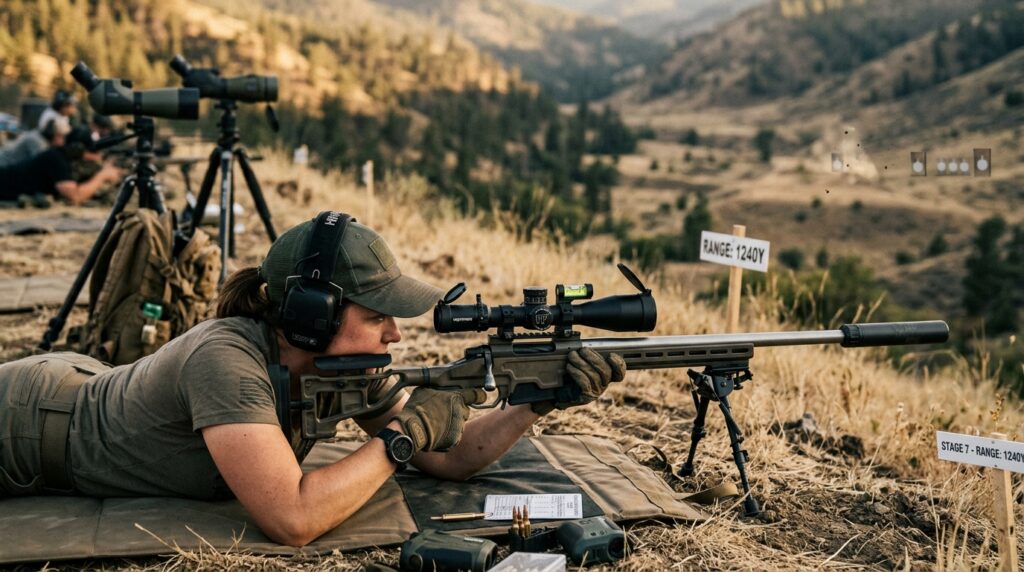
The 360 Precision team has data to back this up. They have run a 6 Creedmoor to a mile on factory Berger ammunition and come in second place in competition. A 6 Creedmoor is not going to drop an elk at 1,000 yards – but it will ring steel, hold its own at distance, and give the shooter a genuinely enjoyable experience doing it.
For a deeper look at how caliber selection plays into a complete precision rifle build, see our piece on the often overlooked 6 Creedmoor and why it punches above its weight class in competition.
Lesson Two: 300 Blackout and the Home Defense Caliber Question
The “bigger is better” question extends to home defense as well, and here the calculus shifts.
For a home defense rifle, 300 Blackout is a genuinely good answer – but for very specific reasons that have nothing to do with bragging rights.
Compared to 5.56/.223, 300 Blackout fires a heavier projectile at a shorter range. In a home defense scenario, distance is measured in feet, not yards. At that range, the heavier .30 caliber projectile is going to have more immediate terminal effect on the target than a lighter, faster 5.56 round. The tradeoff that matters at distance – velocity retention, wind resistance, long-range accuracy – is completely irrelevant when you are shooting across a hallway.
Just as importantly, 300 Blackout offers less over-penetration than 5.56. In a home environment where there are walls and people on the other side of them, that matters significantly.
“For home defense, we are talking very short distance, very close quarters. We care about takedown and terminal ballistics. Accuracy – if you can shoot a pie plate at 100 yards, that is good enough.”
The accuracy threshold for a home defense rifle is essentially the width of a human torso at 10 to 20 feet. You do not need sub-MOA performance. You need reliability, manageable recoil, and terminal performance at close range.
Lesson Three: 5.56 vs .223 vs .223 Wylde – What Is Safe and What Is Not
This is one of the most common questions the 360 Precision team gets behind the counter, and it is also one where getting the answer wrong can destroy your rifle.
The Core Difference
5.56 NATO and .223 Remington use the same bullet diameter. The projectiles are essentially interchangeable at the bullet level. What is different is the chamber pressure.
5.56 NATO operates at approximately 58,000 PSI. .223 Remington operates at approximately 55,000 PSI. That is a meaningful pressure difference – 5.56 is a hotter load by design. The military specification favors higher velocity and reliable feeding in automatic weapons over precision accuracy.
Why This Matters for Your Rifle
If your barrel is chambered in .223 Remington, you can only safely shoot .223 Remington. Chambering a 5.56 round into a .223 Remington barrel is physically possible – they share the same projectile diameter. But the higher pressure of the 5.56 load was not what that chamber was designed for, and you risk damaging the barrel, the action, or the bolt. In a lower-quality firearm, the consequences could be significantly worse.
“You can chamber a 5.56 into a 223 Remington gun. You are just going to have a real bad day.”
One of the gunsmiths described a personal incident involving an overloaded .338 Lapua handload as a reference point for what excessive pressure does. Even in a high-quality custom action with a premium barrel, the round expanded the barrel, locked the action and barrel together permanently, pushed back the bolt headspace by approximately 20 thousandths of an inch, and destroyed both an approximately $1,700 action and an $850 barrel.
“You are talking about a loss there. You definitely do not want to go do that.”
Always check your barrel marking. The chambering is stamped on the barrel. That marking tells you exactly what is safe to run through it.
What Is .223 Wylde?
.223 Wylde is not a caliber. It is a chamber specification – and understanding the difference is important.
A .223 Wylde chamber combines the best of both worlds by using a slightly longer freebore (throat) than a standard .223 Remington chamber. That longer throat gives the higher-pressure 5.56 round additional space to allow pressure to drop before it fully engages the rifling. The result: you can safely shoot both 5.56 and .223 Remington through a .223 Wylde chambered barrel.
The additional benefit is accuracy. Because .223 Wylde retains the tighter chamber geometry of .223 Remington while accommodating the pressure of 5.56, it delivers better accuracy than a pure 5.56 chamber. You get safety with both calibers and precision with the tighter round.
“It combines both of them into the best of both worlds. They make the freebore a little bit longer in the chamber which allows the pressures to drop so you can shoot the 5.56 safely and you get the accuracy benefits of the .223 Remington.”
This is why 360 Precision chambers most of their rifles in .223 Wylde. It allows customers to run either load, and it prioritizes accuracy – which is the company’s whole point.
“360 Precision. Accuracy matters.”
If you want to understand more about how chamber specifications and caliber choices intersect with barrel performance, see our best steps for accurizing your rifle for a full breakdown.

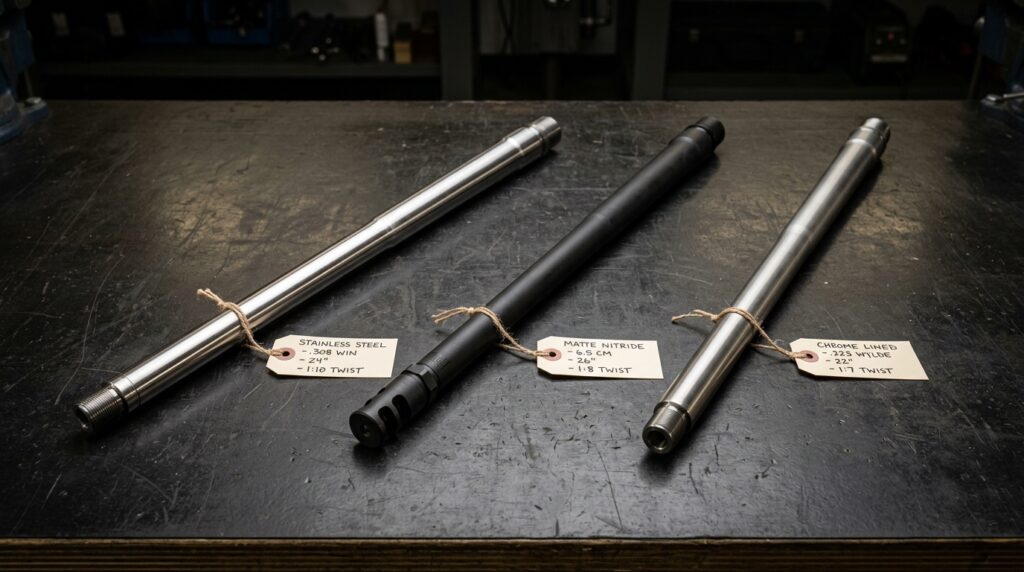
Lesson Four: Stainless vs Nitride vs Chrome Lined Barrels – Decoded
The third major question in this episode is one that comes up every time someone is spec-ing out a new build: which barrel type is right? The 360 Precision team uses all three across their product line, and each one exists for a reason.
The answer, as with caliber selection, comes back to purpose.
Stainless Steel (416R) – Maximum Accuracy
Stainless barrels are made from 416R steel – a designation worth understanding. 416 and 416R are not the same. 416R is purpose-built for high-performance accuracy barrels. The R designation indicates a specific steel treatment process that produces a more consistent microstructure, which translates directly to better accuracy.
The tradeoff: stainless barrels have a shorter service life than treated alternatives. There is no coating or surface hardening to slow wear – the rifling is in direct contact with the projectile from the first shot to the last. You will get fewer rounds out of a stainless barrel, and it requires more attentive maintenance. Store it without oil, and you can develop pitting inside the bore that directly impacts accuracy.
“If you want the highest accuracy, a stainless steel barrel is going to be your highest accuracy option. That is why we use it on our Recon and Evolution rifles.”
For precision builds where accuracy is the primary goal and the owner understands the maintenance commitment, 416R stainless is the top choice.
Nitride – The Middle Ground
Nitride barrels start as 4140 or 4150 GBQ (Gun Barrel Quality) steel and are then subjected to a nitriding process that embeds a hardened surface layer into the steel rather than adding a coating on top.
This distinction matters. Because the nitride treatment penetrates into the steel rather than building up on the surface, it adds essentially no measurable thickness to the bore. The interior dimensions of the barrel remain consistent and accurate. At the same time, the significantly increased surface hardness of the nitrided layer dramatically extends barrel life compared to bare stainless.
“You get better accuracy than chrome-lined because it is a thinner, more consistent coating. And you get more life expectancy than straight stainless because it has a finish on the inside that reduces friction and gives it higher lubricity.”
360 Precision uses nitride barrels on their BR1 rifles – a platform that balances accuracy with durability for shooters who want performance without the maintenance demands of bare stainless.
Chrome Lined – Hard Use and High Volume
Chrome lined barrels are made from 4150 CMV (Chrome Moly Vanadium) steel with a chrome lining applied to the interior of the bore. This is the standard for military and duty rifles, and the reason is straightforward: chrome-lined barrels last a very long time under hard use.
We are talking 30,000 to 40,000 rounds before replacement in some cases. For a rifle that is going to see sustained high-volume shooting, hard handling, infrequent cleaning, and demanding environmental conditions, chrome lining is the right answer.
The tradeoff is accuracy. Applying a chrome lining to the bore interior introduces some variance – the coating cannot be perfectly consistent throughout the length of the barrel. That variance costs you some precision.
“The accuracy is not going to be as good as the previous two because you are adding a coating to the inside of that barrel, and you cannot guarantee it is going to be perfectly coated throughout. It can hurt your accuracy a little bit.”
However, quality matters here. A high-end chrome-lined barrel from a reputable manufacturer can still achieve approximately 1 MOA with .223 ammunition – genuinely useful accuracy for a defensive, duty, or hard-use rifle. The accuracy tradeoff is real but not catastrophic.
360 Precision uses chrome-lined barrels on their RCQB rifles – their hard-use and defensive platform – precisely because that application prioritizes durability and volume over match-grade precision.
“If you are a really heavy shooter putting a lot of rounds through this gun, or you are hard on your equipment and you do not clean it as often, chrome-lined is where you want to go.”
For a look at how barrel material, wear, and care affect long-term accuracy, see our detailed breakdown of what a worn barrel actually does to your accuracy – including what the inside of a shot-out barrel actually looks like.
The Through-Line: Purpose Drives Every Decision
Every answer in this episode points back to the same starting point. Before you decide on caliber, bullet weight, or barrel type – ask what you are trying to accomplish.
A target shooter at a PRS match needs low recoil and the ability to spot shots. A hunter going after elk at a distance needs terminal ballistics and retained energy. A home defense owner needs close-range effectiveness and minimal over-penetration. A duty shooter needs a barrel that lasts 30,000 rounds without losing function.
None of those answers are the same. And none of them are answered by “go bigger.”
The 360 Precision team puts it simply: the shooters who get this right are not necessarily more experienced. They are just asking the right question first.
If you want to get into the broader conversation about how shooting fundamentals connect to equipment selection, our piece on the fastest way to get a bad reputation at shooting matches covers the habits and mindset that separate deliberate shooters from everyone else. And for a look at what wind actually does to different calibers at distance – directly relevant to the BC conversation – see our breakdown of wind calls and gun speed.
Subscribe to the Accuracy Matters YouTube channel and follow 360 Precision on Instagram for new episodes, builds, and range content.